
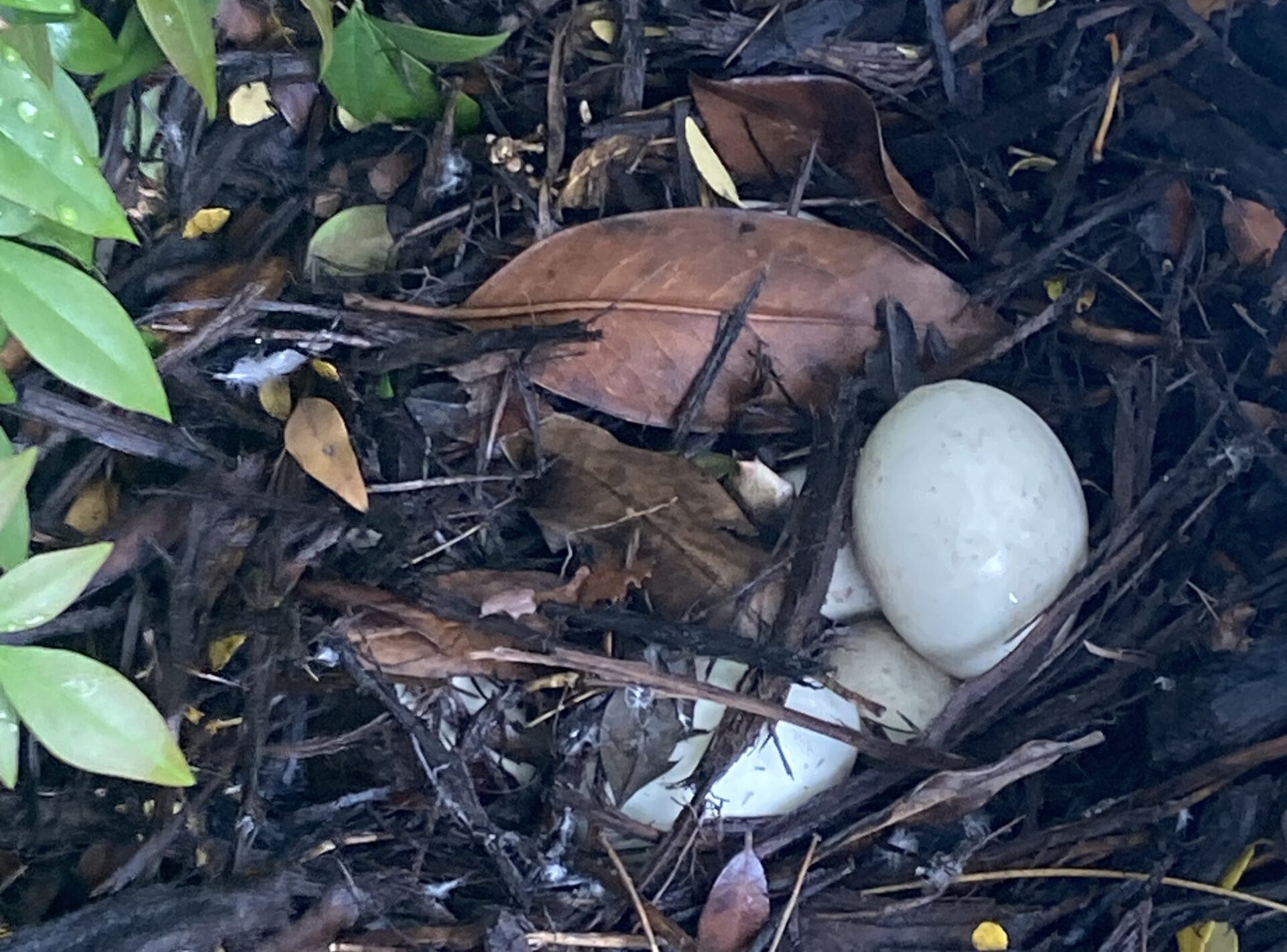
Mother duck Feathers laid her eggs, and the incubation period began. Photos courtesy of Judith Banes.
Editor’s note: This article was submitted by Judith Banes, who has lived at senior living campus CC Young, north of Mockingbird Lane, with her husband for eight years. She also retired from Southern Methodist University.
“Feathers” (a female Mallard duck named by a resident’s grandchild) returned to the CC Young campus in spring 2025. Residents were glad to see her return after watching her ducklings hatch last summer. Once her nest location had been established, she laid nine eggs at the rate of one per day or one every other day. Talk about a project that took patience! And wonder how she knew when she was through laying eggs? … I DON’T THINK I COULD DO IT!
After all her eggs were laid, the incubation period begins and lasts for about a month or less. Starting May 7, we would always find Feathers sitting on her nest. We’re not talking just a few hours a day; no, it was a 24/7 obligation. (Though she could take about an hour to go find food and water, but otherwise her job was sit, sit, sit!) I don’t know about Feathers, but when I’m sitting around with no food accessible, that is when I’m the hungriest. Can you imagine just sitting there ALL DAY? … I DON’T THINK I COULD DO IT!
When residents became aware of Feathers’ location, they would go by her nest and peer over the fence that had been erected to keep the dogs and other animals out. Though she was often facing different directions, one could always find her atop her nest made of vegetation from surroundings and down from her feathers. The down makes the nest a little softer but how uncomfortable and BORING. The only entertainment was the big creatures who stuck their heads over the fence ALL DAY. … I DON’T THINK I COULD DO IT! (Especially since I like my privacy!)
Growing up I loved Hans Christian Andersen’s writings. One of my favorites stories was “The Princess and the Pea.” The story involves testing whether someone was really a princess by putting a hard uncooked pea under 20 mattresses and 20 feather beds to see if she could feel it. If she did, it was determined that she was a princess. I don’t think Feathers would be made uncomfortable if a pea was added to her nest, but can you imagine how lumpy and uncomfortable sitting ALL DAY on nine eggs would be? … I DON’T THINK I COULD DO IT!
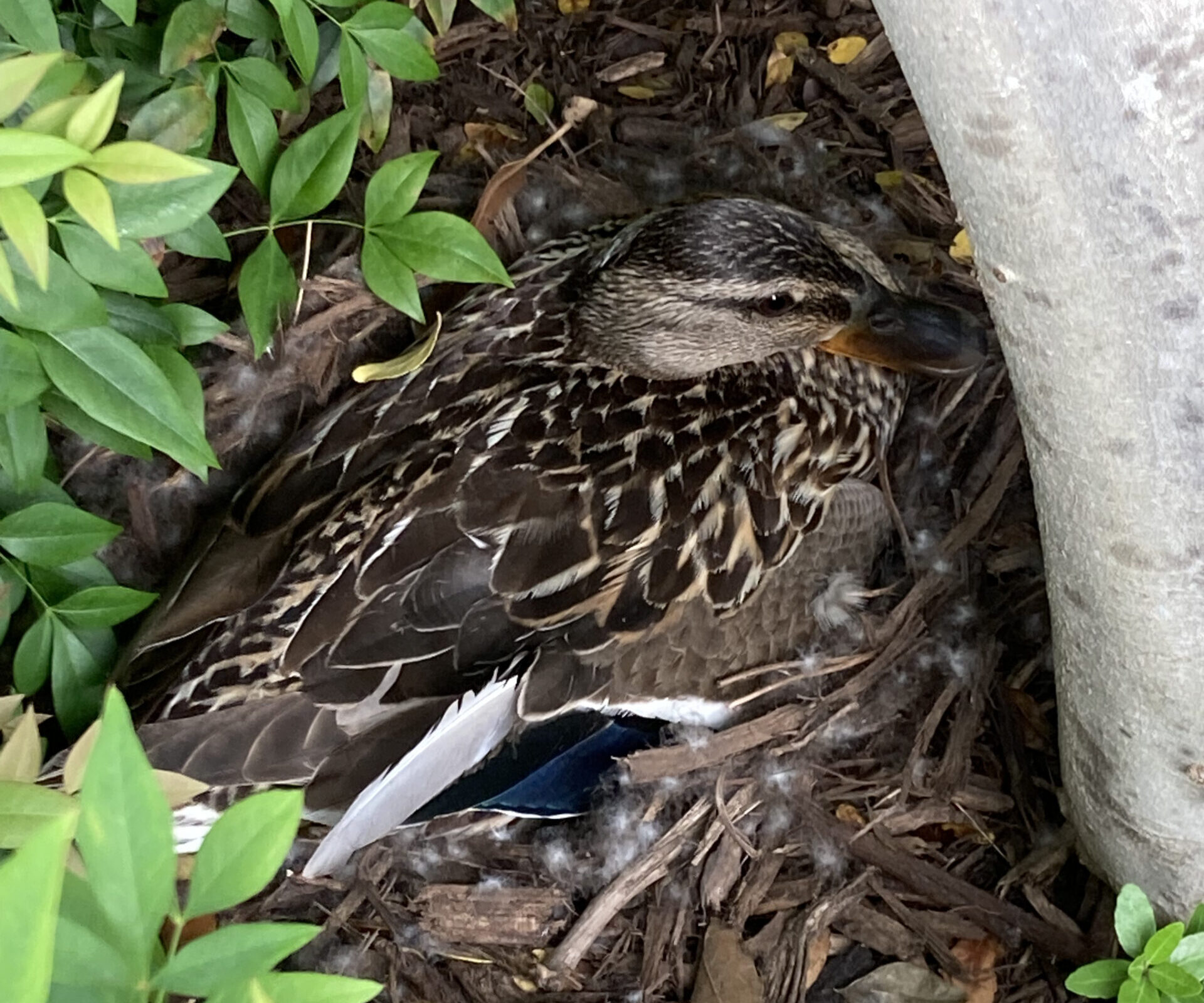
Feathers would face different directions while sitting on her nest. Photo courtesy of Judith Banes.
Humans expecting a baby can feel its movement before it arrives. Did Feathers feel anything before the ducklings broke through their shell? And if not, what about when they began pecking through their shells … all nine of them. Surely, that would be like an earthquake. Then, once the ducklings hatch, it takes two hours for them to strengthen and get accustomed to their legs. Then they are ready to go for a walk and find water. As a brand-new mother, I remember how long it took to get used to having ONE new member of the family. Can you imagine NINE new members?!? I DON’T THINK I COULD DO IT!
While waiting for the eggs to hatch, I would make daily visits to check on Feathers. During this time, I investigated the role of the male Mallard duck, called a “drake.” I was curious because as soon as Feathers finished laying her eggs and started the incubation process, Feathers’ drake disappeared. Poor Feathers, left to fend for herself, keeping the eggs warm and safe while leaving her nest only to find nourishment to keep herself healthy. The more I learned about Mallard ducks’ mating process, the more I admired Feathers; but it solidified my opinion that I COULD NEVER DO WHAT FEATHERS DOES!
Drakes in the winter and spring are identified by their beautiful iridescent green head, white collar and pale gray body. That gets them ready for the mating season. Do you think the females are impressed? I know humans are. It is during the mating season that males are around to help. “Help” is defined as (1) watching the female select a nesting site, (2) watching the female construct a shallow scrape in sheltered vegetation well-hidden from view of predators and (3) observing her laying her eggs (called a clutch). His only real “help” is protecting the nest until the clutch is laid. Then, he disappears. NO, I COULD NEVER DO WHAT FEATHERS DOES!
Feathers was, then, left alone to take care of her clutch. Her job included keeping the eggs evenly warm by using her bill to rearrange and turn the eggs. She always kept them hidden for the short time she vacated the nest to find food and water. Plus, she must keep the nest dry and safe during rain and windstorms (like the 1.5 inches that fell on Memorial Day). The only real way Feathers could fight daily boredom was changing her direction on the nest. NO, I COULD NEVER DO WHAT FEATHERS DOES!
Sunday morning, June 1, started out like every other day. The first item on my morning walk was to visit Feathers. And, sure enough, there she sat on her nest, just like the previous 24 days. She was sort of puffed up, but otherwise, she looked like she always looked, content on her nest. Because it was hard to predict when her eggs might hatch, we anticipated some action maybe starting later that week.
After I finished my walk and returned to our apartment, I got a call from Kathy Ramirez telling me that the ducklings had hatched. Immediately, I went back over to see them. Slowly, but surely, we witnessed one duckling after another sticking their head out from under Feathers. Several fuzzy heads would stick out from under Feathers, then retreat under their mom. We could also see unhatched eggs which led us to believe it would be a while before she would be leading them to water, but we were wrong.
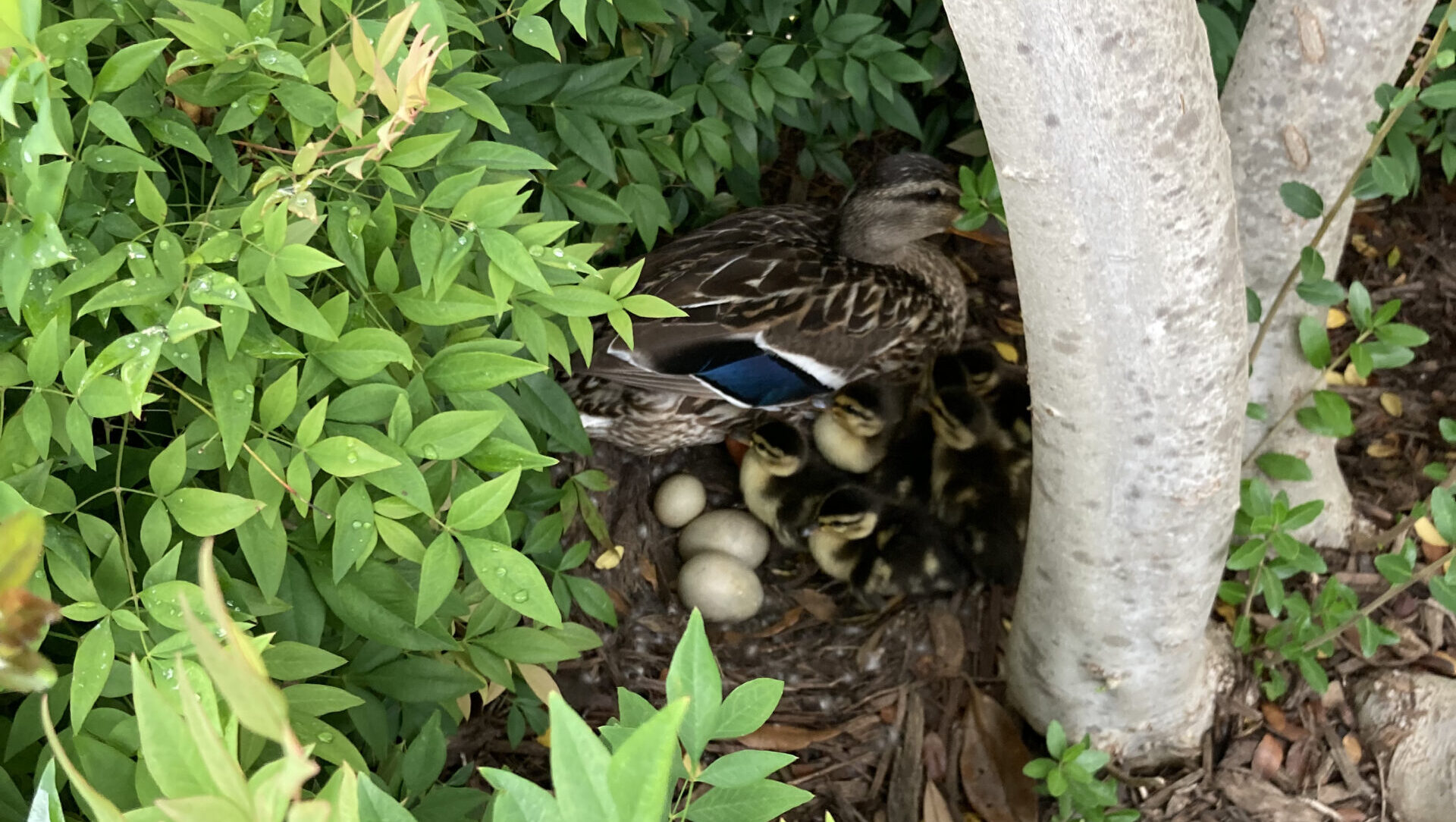
Feathers welcomes her new chicks. Photo courtesy of Judith Banes.
As the crowd of residents had grown, soon Feathers decided it was time to head to water leaving three unhatched eggs behind.
She marched out of her secluded hedged area with her six ducklings following, and the parade began. As the residents made room for her, she appeared to know what she was doing. Her confidence and leadership led the parade down the road to Lawther Drive with her little ducklings’ legs working on “fast forward” trying to keep up.
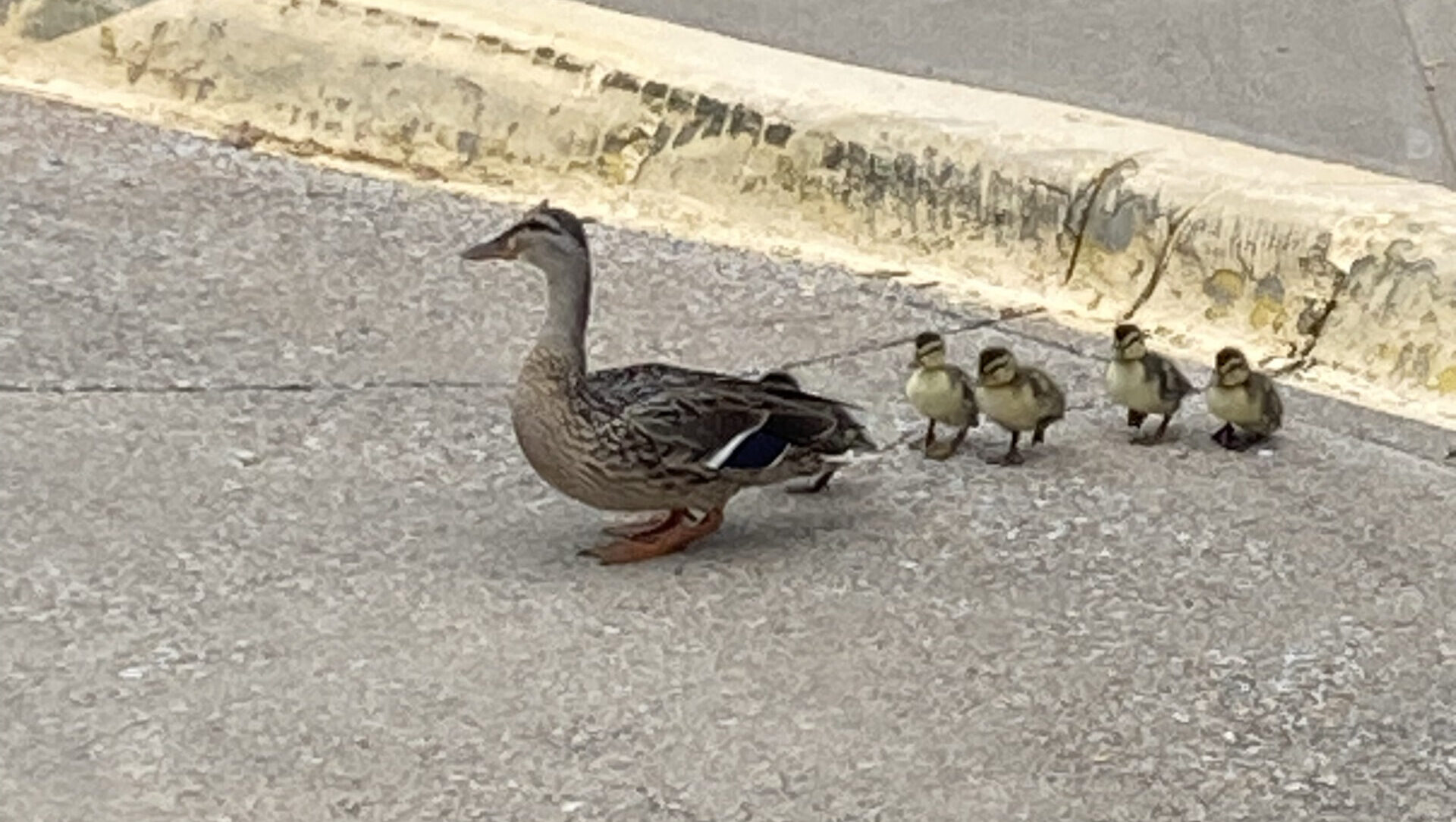
Feathers and her hatchlings leave the nest. Photo courtesy of Judith Banes.
A large group of residents quickly followed behind not wanting to miss the excitement, and the entourage made its way toward Lawther Drive.
Given that it was Sunday morning, traffic was slow, and residents easily stopped traffic on the highway.
There were no problems getting Feathers and her brood across the highway and up the curb. Feathers then left the residents behind and led her ducklings down to the river below. The ducklings can swim and feed themselves immediately, but it will be Feathers’ sole responsibility to care for the ducklings for the next six to eight weeks.
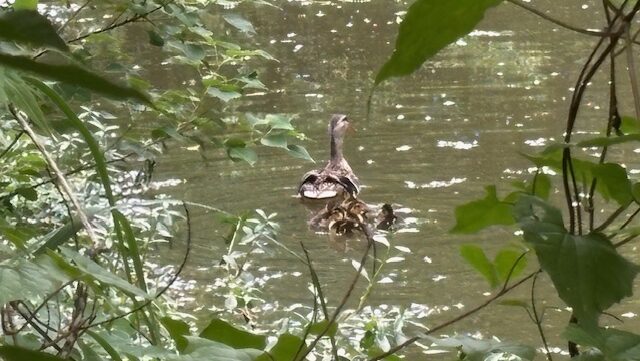
Feathers left the residents behind and led her ducklings down to the river below. Photo courtesy of Judith Banes.
As the residents returned up the hill, their memories were bursting with excitement and gratitude at experiencing nature, witnessing God’s plan and being an integral part of a great community. Throughout the day, this wondrous new life event was shared with others through photos and stories. With each transfer of the experience, residents cherished the value of new life and God’s plan was celebrated.
Since this is the second year Feathers has selected CC Young as a wonderful place to build her nest, we hope we will have the opportunity next year to again experience the observation and anticipation of nature in action. Until then, we know Feathers will be exhausted after fulfilling her duty as a good mother. She deserves to take some time for herself, and that is something I CAN DO!
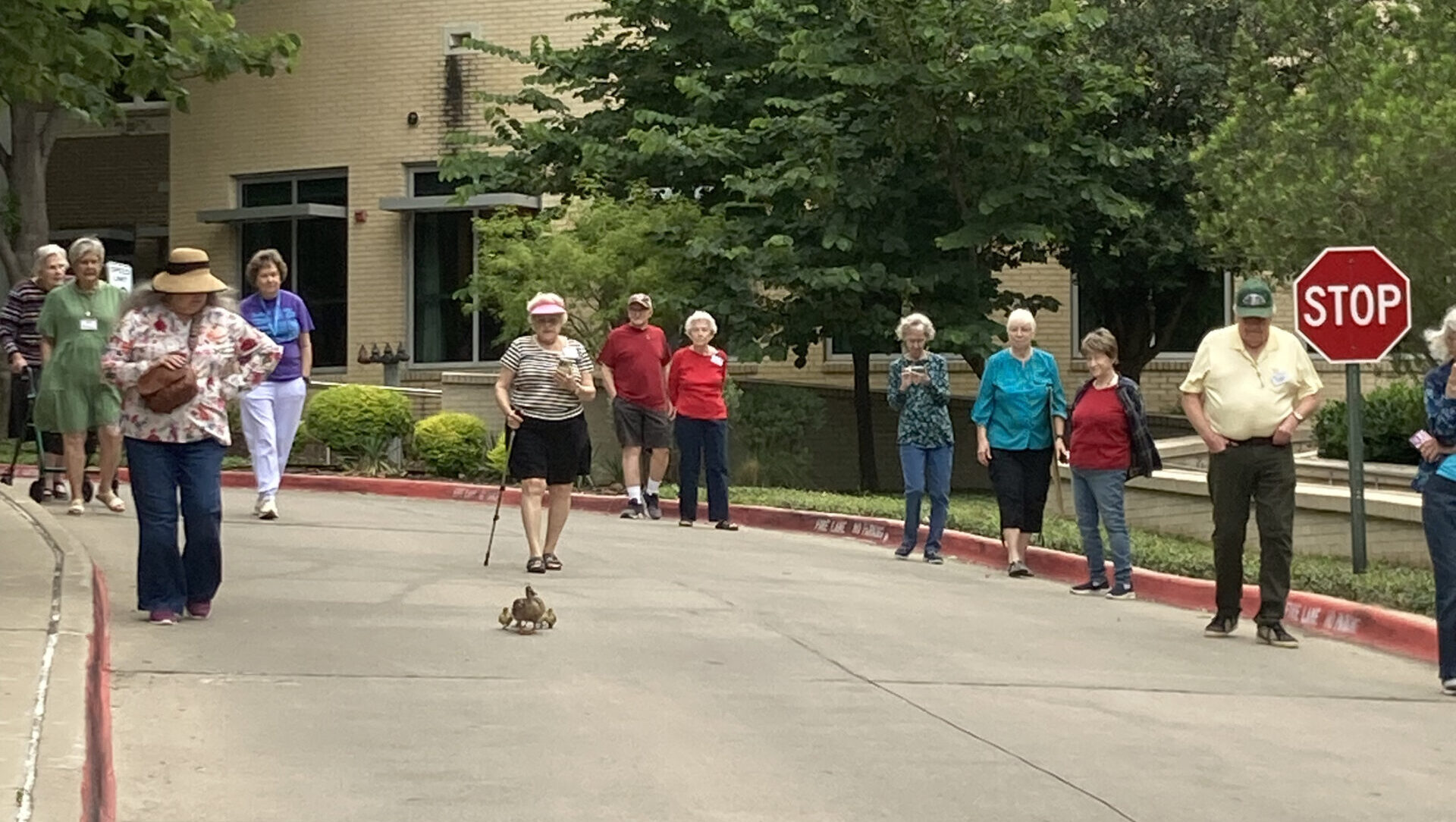
CC Young residents follow Feathers and her brood as they leave to find water. Photo courtesy of Judith Banes.