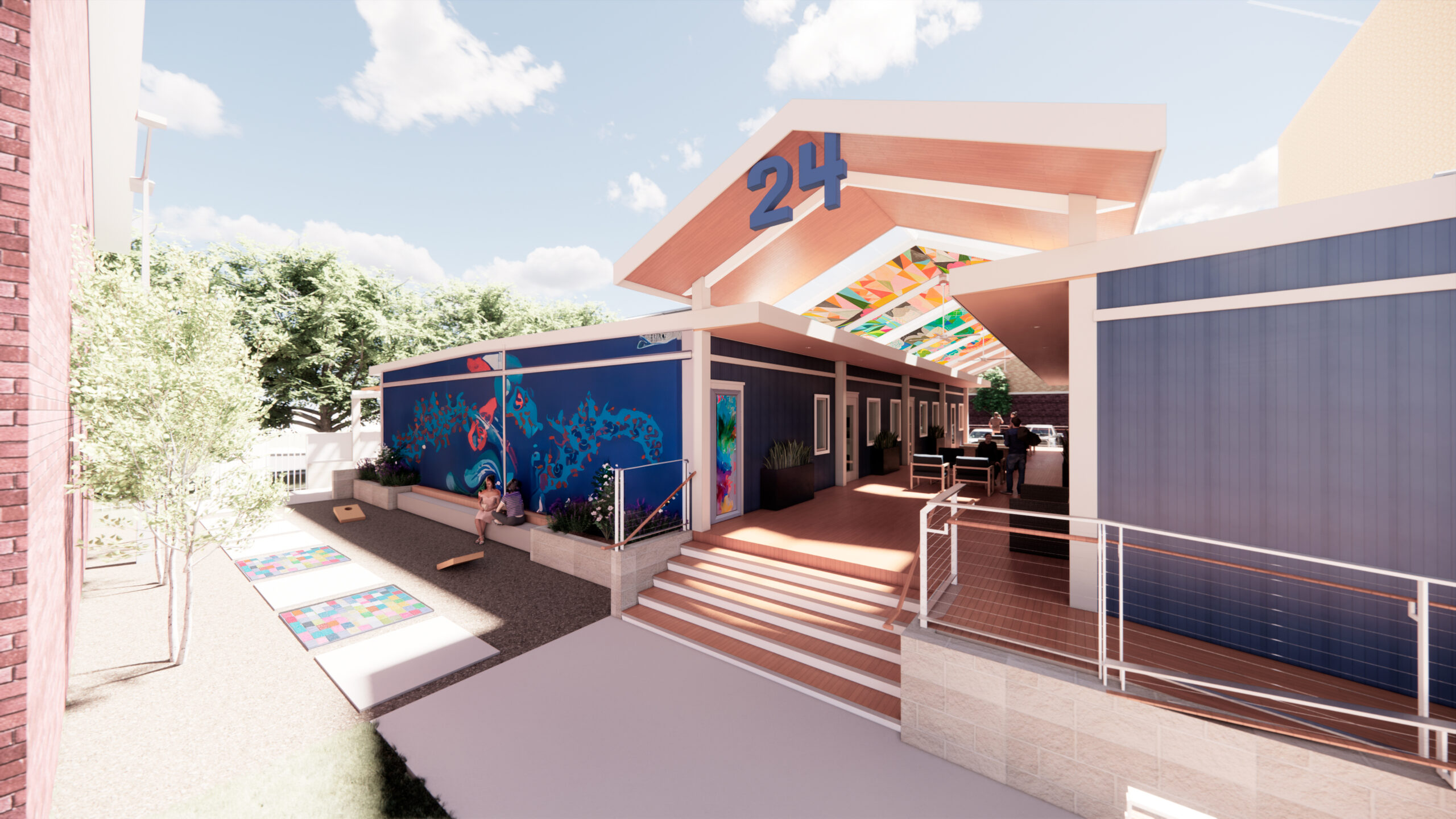
Rendering of the Dallas 24 Hour Club’s new facility Trevor’s Place, which is expected to open in September. Renderings Courtesy HKS Architects.
Trevor’s Place, a new facility on Dallas 24 Hour Club’s campus, is under construction and is expected to further support the wellbeing of The 24’s residents who are in recovery from drug and alcohol use.
The Old East Dallas nonprofit offers transitional housing and other services to people who are homeless and struggling with addiction to help them stay sober and be self-sufficient.
Trevor’s Place, named after someone who passed away from a drug overdose, will be next to the Tillman House on Peak Street in a space that used to belong to Reconciliation Outreach Ministries. The new facility is expected to include flexible community space, a technology lab, gym, library, meditation garden and curated art installations.
Trevor’s Place has always been a dream for the Dallas 24 Hour Club, CEO (and former resident at The 24) Tim Grigsby said. While the Tillman House has been successful in aiding recovery, it’s purely residential and doesn’t have space for programs and amenities.
“There’s no community area; there’s no technology space; there’s no real area for people to get together,” Grigsby said.
That’s where Trevor’s Place comes in. It will allow residents to build community with their peers, access computers to take online classes, exercise their bodies and attend larger life skills classes. Helping residents achieve sobriety is the main goal of the Dallas 24 Hour Club, but teaching them to be self-sufficient is also a priority, Grigsby said. Extending education to residents through partnerships with Dallas College and the Construction Education Foundation helps to meet this goal.
“The MIT study that comes out once a year, the cost of living study has us in Dallas at $23.06 an hour to be able to live independently (for single adults). And that’s what we preach to our people is we want you to live independently,” Grigsby said. “So we need to match that. We need to meet that goal, and Trevor’s Place is a response to that. Our residents need life skills, they need wraparound services, and they need education and better paying jobs. And so Trevor’s is meant to meet that community need for our residents.”
The meditation garden will be a green space outdoors with a mural on the nearby wall and will allow residents to sit down and connect with nature and with their higher power. Art will be implemented in Trevor’s Place as it is at the Tillman House. When the Tillman House first opened, “there was no art. It was just white walls, and it felt very institutional,” Grigsby said. “And we have all this fine art here (now), and it’s made a world of difference in making this place feel like a home.”
Grigsby said there will be two to three curated art installations, which will be led by Board Vice Chairperson Gavin Delahunty, at Trevor’s Place.
“We believe that art can be healing and help with trauma,” he said.
Trevor’s Place is being made possible through a capital campaign with in-kind donations from HKS Architects and Gordon Highlander, as well as from multiple other subcontractors. The campaign is still running, and people are able to continue donating.
The nonprofit also raised $208,635 at its second annual “Fore The 24” Golf Tournament on May 19, which surpassed the fundraising goal set for that event. The money raised at the tournament goes toward providing housing, meals, wraparound support services and tools for long-term sobriety to those in need at The 24.
Trevor’s Place is expected to open in September.
“The 24 Hour Club has been helping people and it’s been a cornerstone of their recovery community since 1969, but the needs of the community are changing,” Grigsby said. “We’re incredibly grateful to be able to really meet our residents where they are and provide those wraparound and educational services, which … it’s going to be needed. We don’t want our people to be left behind, and without an intervention, like intervening on them with technology skills, with life skills and with education, there’s a good chance that they could return to homelessness and poverty and will turn to addiction again.”