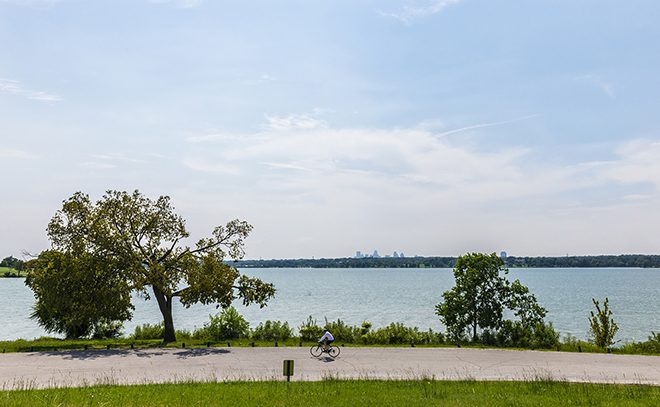
Photo by Danny Fulgencio
A plan for dredging White Rock Lake is coming together.
Dallas Park & Recreation in collaboration with engineering, planning and consulting firm Freese and Nichols hosted a community meeting on this topic Dec. 2 at the Bath House Cultural Center.
White Rock Lake hasn’t been dredged since 1998. Historically, dredging has occurred about every 20 years, and on average, about 170,000 cubic yards of sediment are deposited in the lake every year. Sediment typically comes from upstream, so it could be captured before it gets to the lake, but that idea hasn’t come to fruition. Those who use the lake for boating know that dredging is needed because buildup of sediment creates unsafe water depth.
“We want to restore safe boating depth, improve shoreline aesthetics, minimize impact to sensitive areas, consider long-term sustainability,” Freese and Nichols engineer Patrick Miles said to the Lakewood/East Dallas Advocate.
Freese and Nichols was hired by the City in 2020 to study the feasibility of dredging White Rock Lake. Two years later, the firm was authorized to provide preliminary engineering design services via a contract with the City.
Back in August, the Dallas City Council authorized a project partnership agreement with the U.S. Army Corps of Engineers for preliminary engineering design services. This means the federal government was able to pitch in $2 million for the project, and the City will have to match that contribution by no more than $666,666.67, according to the resolution.
“We are now closer to renewing and sustaining the gem of Dallas for future generations,” District 9 Council member Paula Blackmon said in a statement when this agreement was approved.
Dallas voters also elected for $20 million to be spent on the dredging project in the 2024 bond.
The Army Corps of Engineers were expected to start design on the project last month and finish in May 2028, according to Blackmon’s previous statement in August. Then, construction would start in August 2028 and be completed in December 2029.
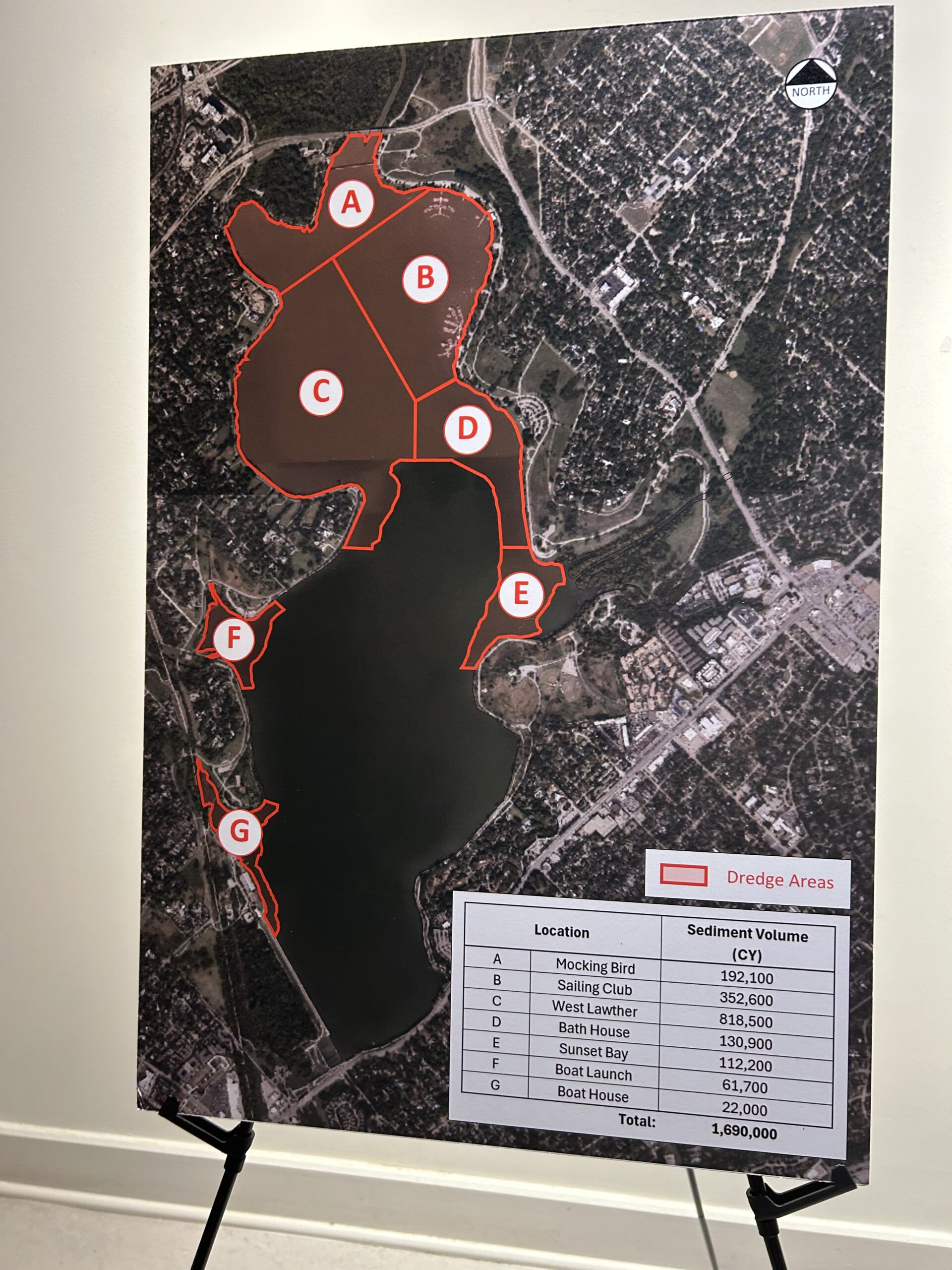
The north end of White Rock Lake, especially along West Lawther Drive, tends to have the most sediment distribution. Photo by Madelyn Edwards.
The Dec. 2 meeting touched on the feasibility study, the dredging process, project updates and next steps. Freese and Nichols found that dredging the whole lake to its target depth would mean removing a lot of sediment — about 1.7 million cubic yards — which could be used for other purposes on land, like covering a landfill, top soil, composting or fill dirt.
“That’s really a big question is what do you do with the material once it’s out,” Miles said. “And hopefully the answer is not just, ‘Well, throw it in the pit,’ but the answer can be we can have some beneficial use for it.”
A lakewide dredging project would cost $54-$80 million in 2025 dollars, and the sediment could be transported to McCommas Bluff Landfill in southern Dallas, just north of I-20, to be processed and used there. Of course, if a closer location to process a lesser amount of sediment could be found, that would make this project more affordable.
Speaking of which, fitting a dredging project into the City’s $20 million budget means only removing 300,000 to 600,000 cubic yards of sediment in target areas instead of the full 1.7 million cubic yards.
“The goal here is to establish a dredge program, not just to do a single dredge project,” Miles said during the meeting. “Obviously, this will depend on budget availability, constraints, etc, but the goal here is to be able to dredge on a recurring basis. Take this $20 million initially, and then be able to lay the groundwork for what can happen in the next, say, five to seven years to be able to really not only finish off that 1.7 million (cubic) yards but also to help maintain and combat the 170,000 yards that are continuing to come to the lake on annual basis.”
Blackmon reemphasized this point at the meeting: “We’re trying to create a program and a process that we don’t wake up one morning and go, ‘Oh my God, we now got to find $80 million to dredge,’ and if we kept the infrastructure in ’98, it would have been a lot easier. We’re learning, and that’s what we’re trying to do.”
Coming up with that long-term plan is one of the immediate next steps, along with picking specific areas of the lake to dredge and having a site to process and dispose of the sediment.
White Rock Lake neighbors are encouraged to give feedback on the dredging project via email at district9@dallas.gov or paula.blackmon@dallas.gov.