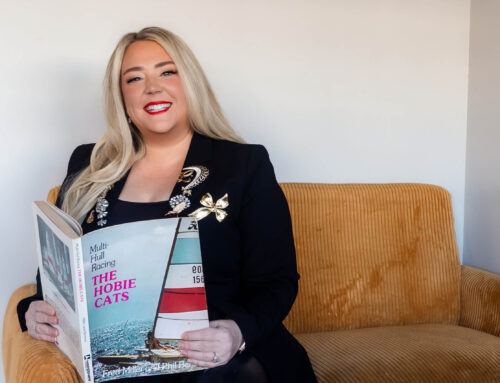
There are two things,” says neighborhood resident Helen Mar Parkin of her career as an art conservator. “What are the paintings supposed to look like, and how do you clean them?”
As an art conservator, Parkin spends much of her time dealing with old paintings that have been damaged over the years. Her job is to take a piece that’s in bad shape and bring it back, as nearly as possible, to the way it looked originally.
“My goal is to bring the painting back to the artist’s intention,” she says.
Parkin has worked as a conservator for more than 30 years. In that time, she has worked on paintings by famous artists such as Thomas Cole and Gilbert Stuart. Last summer, she worked on her most exciting and gratifying project to date, a painting for
Although as a child she loved to copy artwork, Parkin says she has never been an artist herself. So when she graduated from
“It was when I attended a lecture by an art conservator about restoring paintings that were damaged by floods in
So she went back to school to get her master’s degree in museology, and then went on to get another master’s in conservation of historic and artistic works, and she obtained a certificate of advanced study in paintings.
“You need training in art history, studio art and chemistry in this field,” she says.
Since her schooling, Parkin has worked in several different museums, but says she prefers private practice because she gets more hands-on work.
“To me, the bench work is the most enjoyable — the luxury of working on and being close to the painting — being confronted with interesting problems to solve. And that’s what I like. That’s the most interesting.”
When working on more notable paintings, such as the Gainsborough, Parkin confesses that she does get a little bit nervous.
“Of course we try to treat everything the same, but I do get keyed up. It’s exciting to have something special in the studio. But that doesn’t change the way we work on it.”
When commissioned to work on the Gainsborough painting, Parkin hit the ground running.
“I wanted to do as much preparation as possible,” says Parkin, explaining that she sent e-mails to colleagues asking for advice, went to a Gainsborough exhibit, and even interviewed another conservator who had previously worked on Gainsborough paintings.
As part of her work, Parkin learns everything she can about the painting itself, as well as the artist’s style, then she determines the best way to clean it, which can be the most difficult step of the process. She figures out what type of varnish and paints have been used, and then figures out what kind of cleaning system will work without damaging the paint (through a bad chemical reaction).
From there, she fills hundreds of tiny cracks in the painting through a process called “in-painting.” One thing Parkin will never do is paint over anything.
“The painting is sacred; I only do what is necessary. I don’t impose my own style,” she says.
She admits the work can be tedious. On the Gainsborough painting alone, it took a month of work under a microscope just to remove the varnish. But she says she enjoys it.
“Everything that comes in is a puzzle, it’s a challenge. I enjoy the process — getting from here to there. Being able to envision how it will look when it’s finished — I get such a charge out of it,” she says. “The more we (conservators) work, the more we learn, but the more careful we become. We develop a great respect for a work of art.”
Currently, Parkin is working on another piece for the Taft Museum of Art, as well as some contract projects in Dallas for Helen Houp Fine Art Conservation. But she has her hopes set on helping out with a big project in Gettysburg, Pa. — a cyclorama of the Battle of Gettysburg inside the visitor’s center on the battlefield. The center is being torn down and rebuilt in 2006 with the revamped painting. Parkin and Houp’s associate, Perry Huston, of the Kimball Museum of Art in Fort Worth, is heading the project, and they hope to hear word soon whether or not they’ll be able to take part.
“It will be a thrill to be involved in something so historically significant,” Parkin says. And having that place in history is one thing that makes the work so satisfying for her, even though once her work on the painting is complete, it goes back on the wall with visible recognition for the artist only, not the conservator.
“Conservators are anonymous,” Parkin says, “but we know that we have preserved something for posterity, and that is gratifying.”