
Photo by Danny Fulgencio
Electric retail provider TXU pays M Streets resident Rick Green for solar power generated by his house.
Green doesn’t make a profit from TXU. He still has a monthly electric bill, but it’s significantly lower now than before he installed the solar panels on his roof.
He lives in a 2,800-square foot duplex on Ellsworth, and about a year ago hired a company called SolarCity to add the 8-by-30 feet of solar paneling. Green paid roughly $12,000 for both the installation and to lease the panels for 20 years, “which is better than owning because they still have responsibility to maintain them,” he says.
The panels are guaranteed to generate at least 10,000 kilowatt hours (kWh) of power every year, so assuming that electricity costs 10 cents a kWh, Green figures the panels save him roughly $1,000 a year.
“It’s like I pre-paid my electric bill for 12 years,” Green says. After that, any solar energy produced would be free.
Green’s home itself was built in 2008, so it’s fairly energy efficient, but “we have a lot of stuff in the house that has a fairly substantial electric draw,” including five refrigerators. (Green keeps a beer fridge next to his recliner, for example. He’s all about saving energy.)
He estimates that his home uses an average of 2,000 kWh every month. Before the solar panels, that would have meant a monthly bill of about $200, he says, not including fees.
That’s a big difference from his April bill — $74 and some change. The biggest portion of his bill now is taxes and fees; his electricity use accounted for less than half of the bill.
The energy created by the solar panels on Green’s house is first used to power his home. When his home isn’t using all of the solar energy created, it goes back into the grid, and TXU tracks and pays him for that energy.
“I have a two-way meter, and if you look at it, if it’s a sunny day at noon and the A/C isn’t on, you can see that my meter runs backward,” Green says. “Let’s say both of the A/C units kick on, it will start running the other way slowly.”
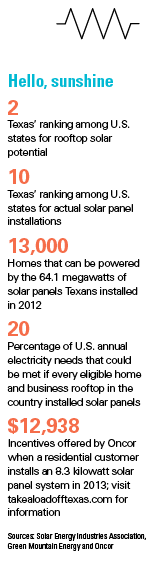
The way TXU’s “distributed renewable generation” program works is threefold. Because Green participates in the program,
TXU charges him a higher rate — 12 cents per kWh — for any additional energy he uses from the regular power grid during the hours of 6 a.m.-10 p.m. TXU pays him 7.5 cents per kWh for any excess solar energy his home produces during those hours. And between 10 p.m. and 6 a.m., TXU doesn’t charge Green for any energy used.
He receives an email each week with his usage report and a breakdown in every bill. In April those hours were split pretty evenly — he used about 500 kWh from the grid and about 500 kWh during the nighttime hours, and received a credit for about 500 kWh of solar energy his home produced for TXU.
“It’s complicated, but once you figure it out, it’s essentially self-maintaining,” Green says. “I never have to think about electricity again, other than every once in a while when we have power outages.”
He doesn’t have the kind of system that continues to run when the power grid is down. That would require a battery back-up system.
Green is glad that his solar panels are hard to see from the street. It’s not a situation where “it’s nice to save $100, but, man, does it make the house ugly,” he says.
“There’s one spot about 300 feet down the block you can kind of see them shining through the trees in the light,” Green says.
The panels don’t produce as much energy in the winter because it’s cloudier, but during a summer month, they might produce as many as 1,200 kWh, he says.
“We’re kind of spoiled in Texas because of the refineries here and such, so much lower electricity costs, but still, one of the things we do have a lot of in Texas is sunshine,” Green says.
He’s a self-described “outdoors guy,” so using the available sunlight to power his house is satisfying. Just as satisfying are the dollars he saves.
“The bottom line is saving money and doing the right thing,” Green says, “not necessarily in that order.”
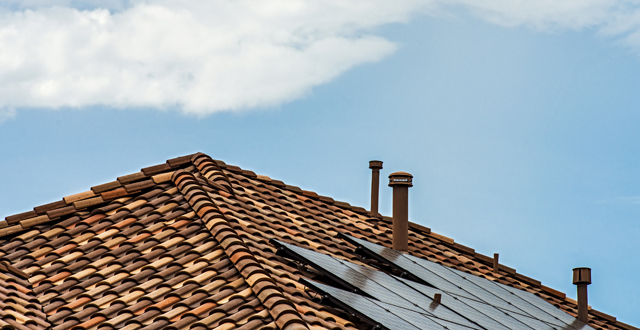
Solar panels atop Rick Green’s home Photo by Danny Fulgencio