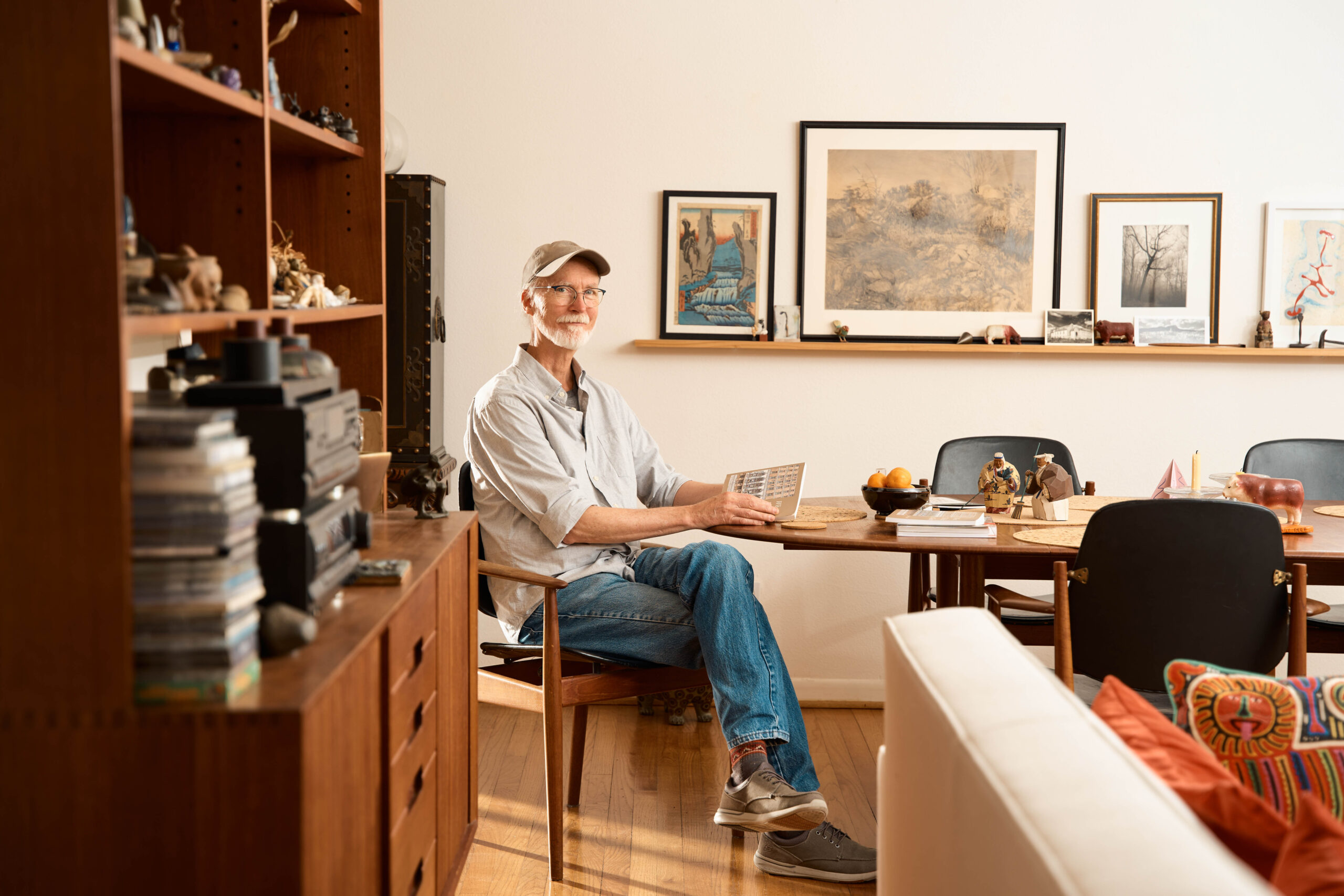
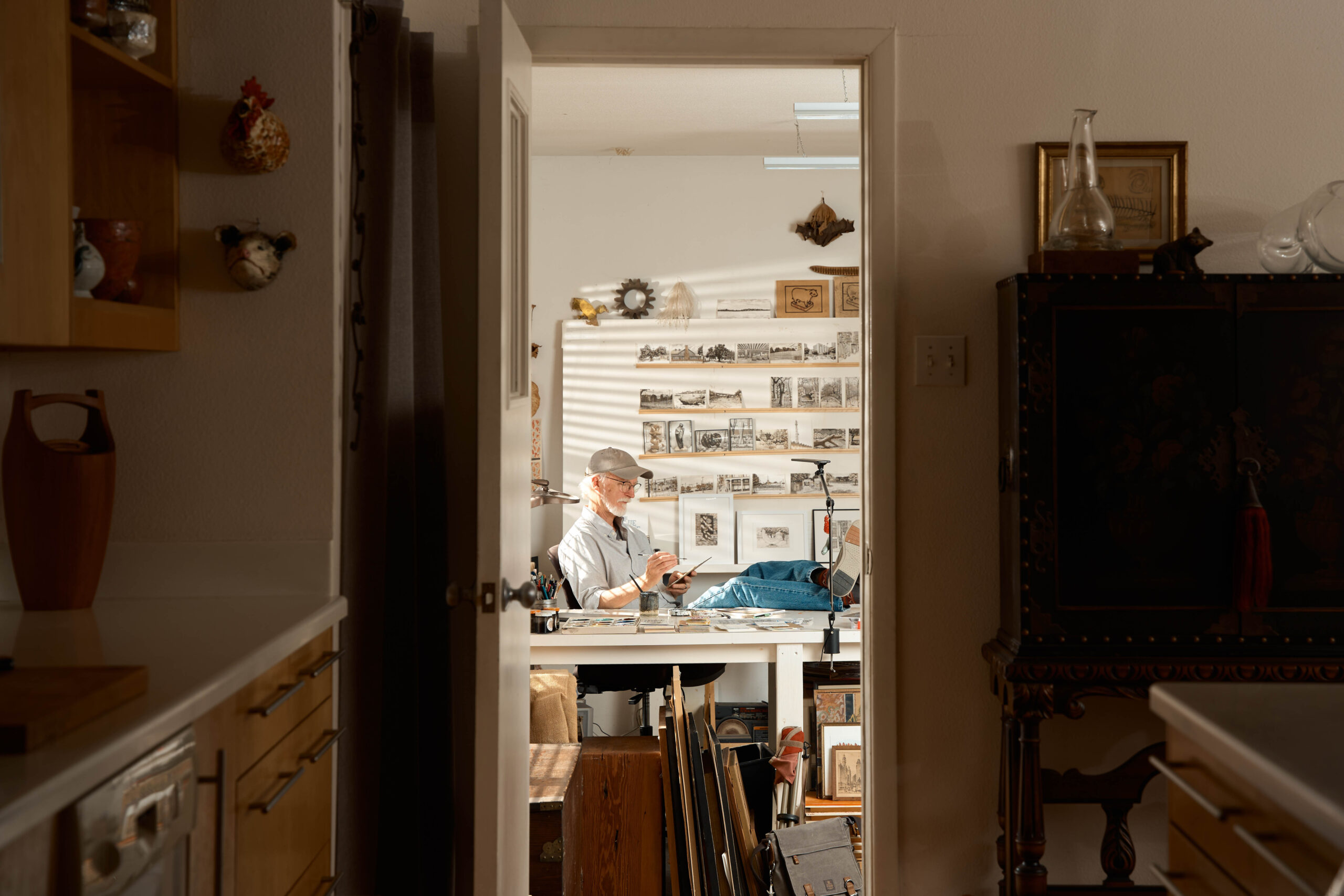
East Dallas neighbor Brad Ford Smith performs a ritual before he draws a landscape portrait of the place where a tragic death had occurred decades prior.
Photography by Ethan Good
Smith takes his camping stool, 4-inch-by-6-inch watercolor paper and a can of local craft beer. At the site, he pours out some of the beer to acknowledge the person who died there. He turns to the four corners of the compass to recognize his own family members and friends who have passed away and serves them part of the beverage.
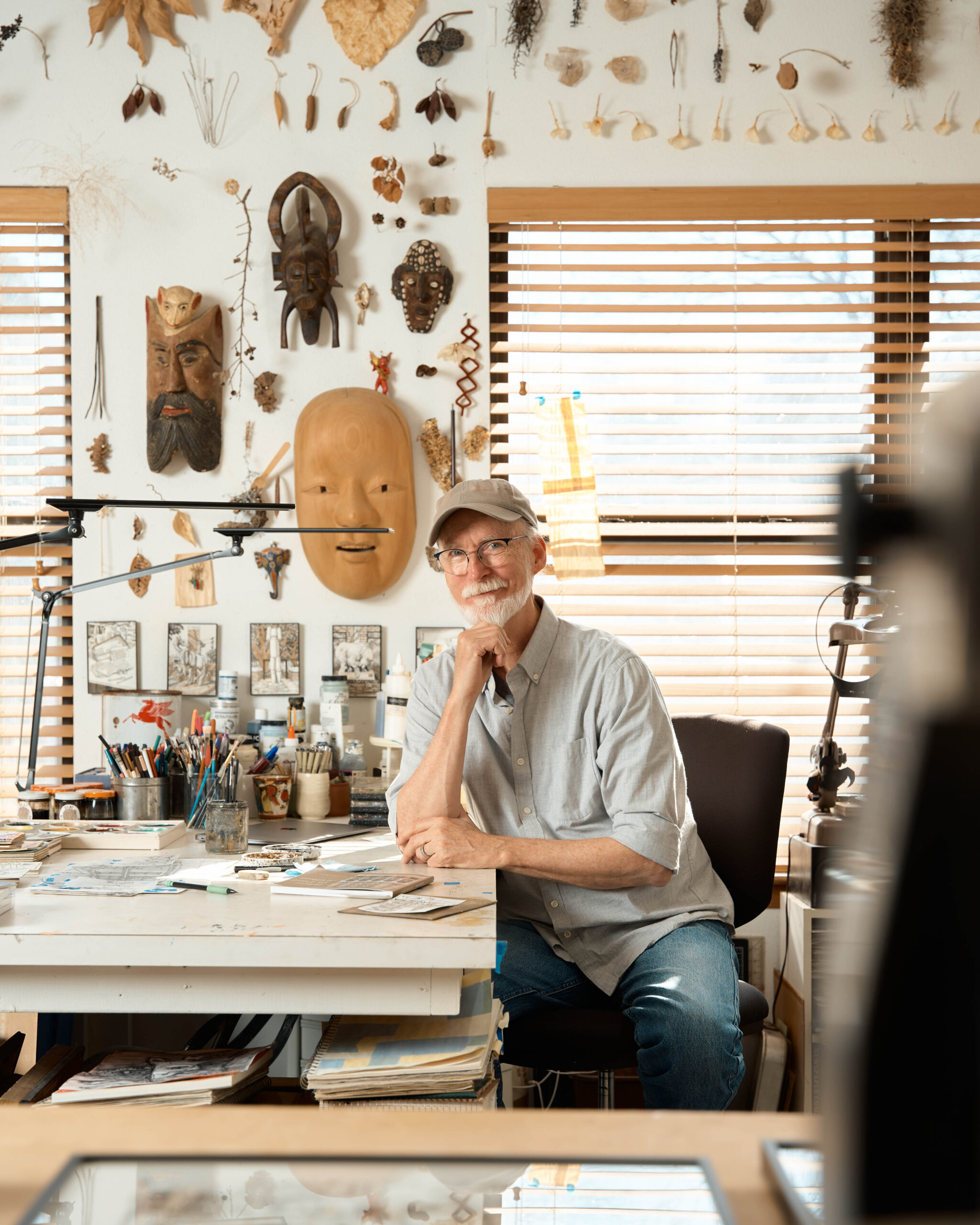
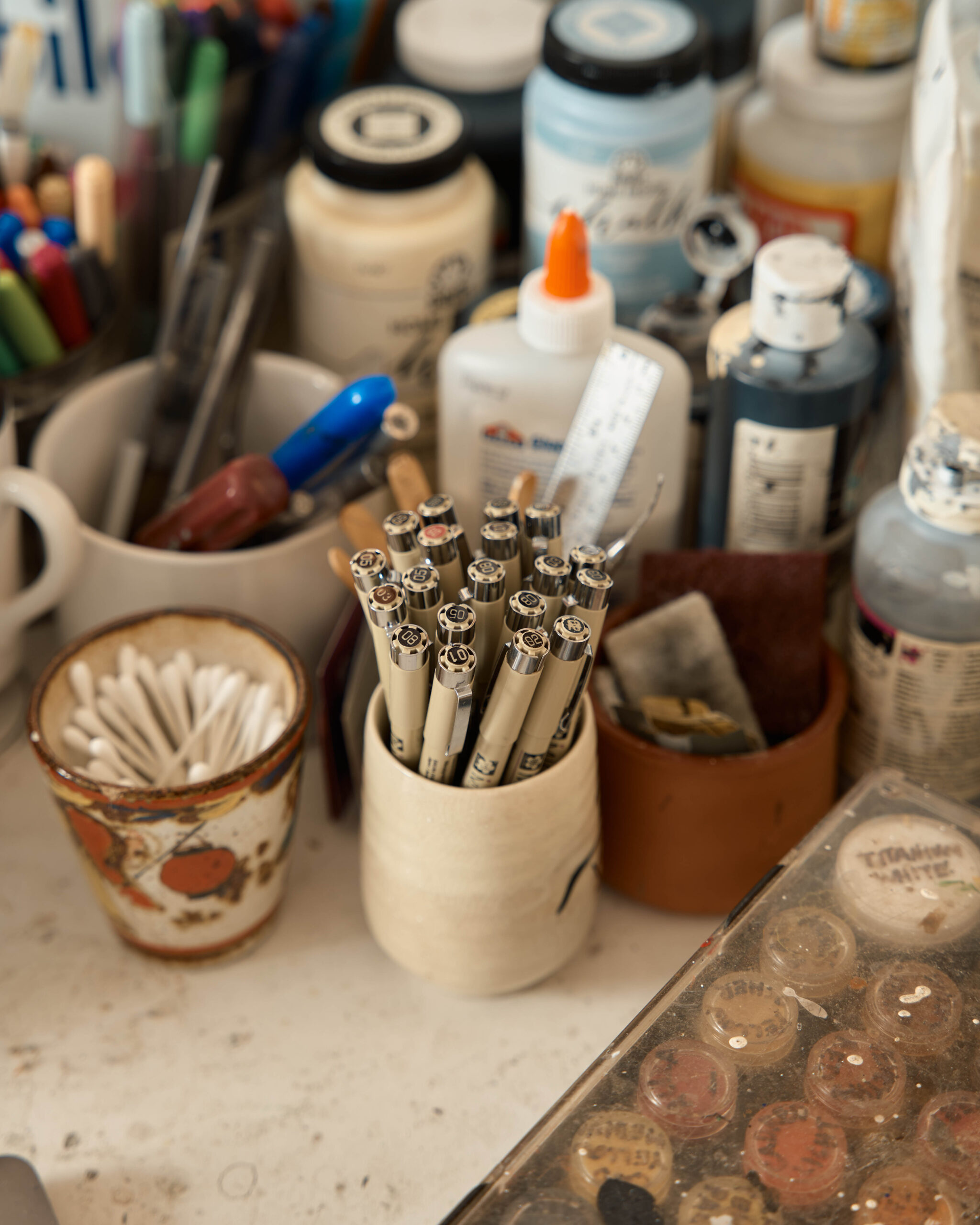
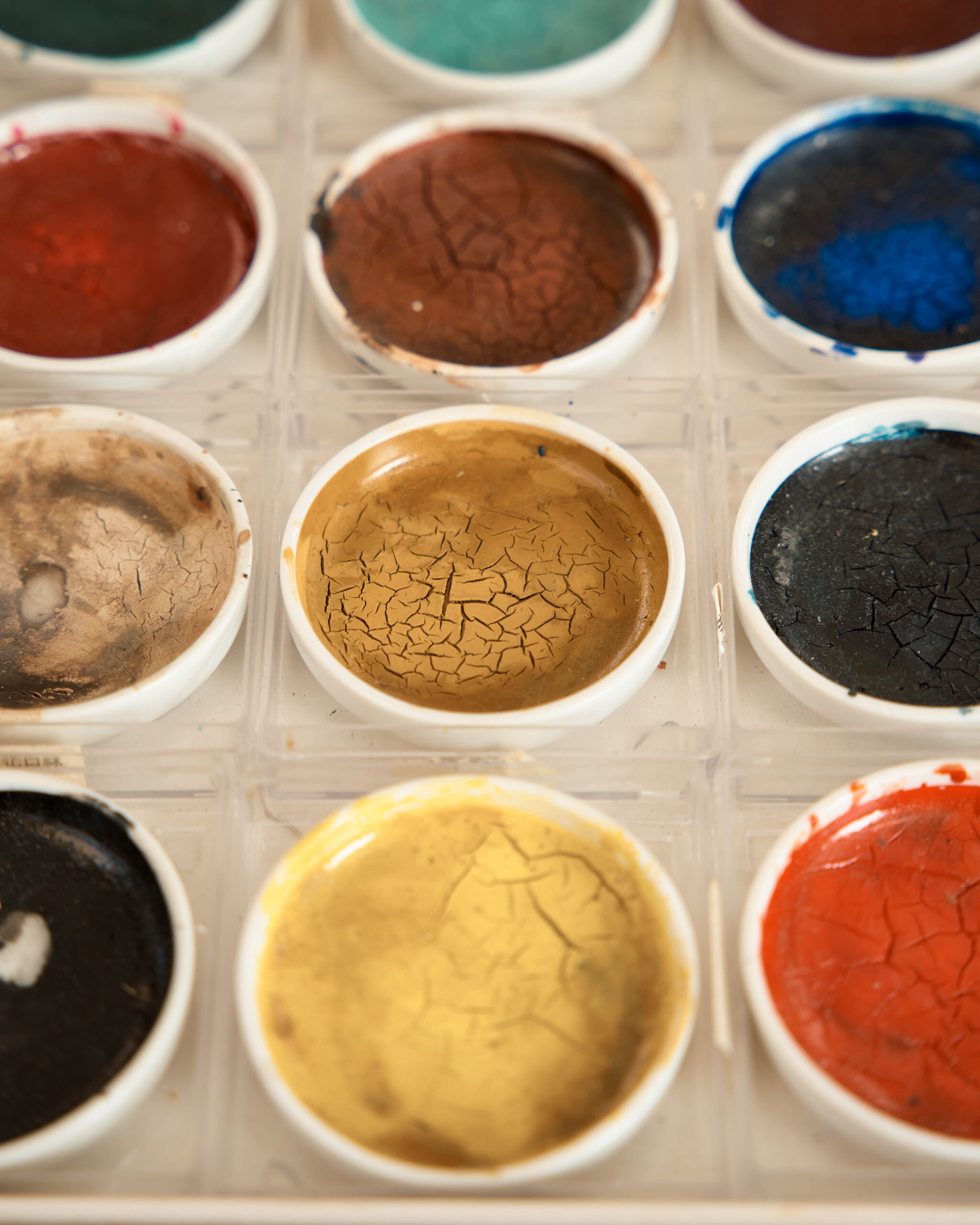
Then, he takes a swig for himself and is ready to create. He draws the landscape at the scene in pencil and finishes the piece at his studio, though sometimes he’ll pull out the inks on location.
“I like to do as much as I can on site because it’s about my connection with that spot,” Smith says. “When you’re working on site, the day is passing, and the shadows are moving, and so you’re not capturing a photograph. You’re capturing a span of time.”
The art that came out of this ritual is what made up Where To Find A Ghost, published in 2025 through Dallas-based K.Co Press. The book showcases Smith’s drawings paired with descriptions of the tragic event that occurred there.
You might be expecting this art to be grotesque, given the subject matter. It’s not. These landscapes that are void of human figures and colored in ink to look sepia-toned are meant to depict what those places are like now. They are locations that you may see frequently in Dallas and not think twice about. And that’s the point.
Smith’s move into art based on reality is the opposite of his previous project, the Nomadic Fungi Institute. That was an experiment in pseudoscience and misinformation. He created the idea of a fictional mutated fungus that eats automobiles and created fake experiments and results while wearing a lab coat at the shows. The scary part came when viewers took the concept seriously.
“There was that whole beginning of mistrust of news feeds, but at the same time, you could put something out there that was just totally fictitious, and people would accept it as real,” he says. “That really bothered me a lot with the Nomadic Fungi. So I backed off of that and started looking at the history around Dallas, my own city.”
Smith grew up in East Dallas in the home he lives in now. His parents were freelance artists and worked in broadcast for Channel 8 (WFAA).
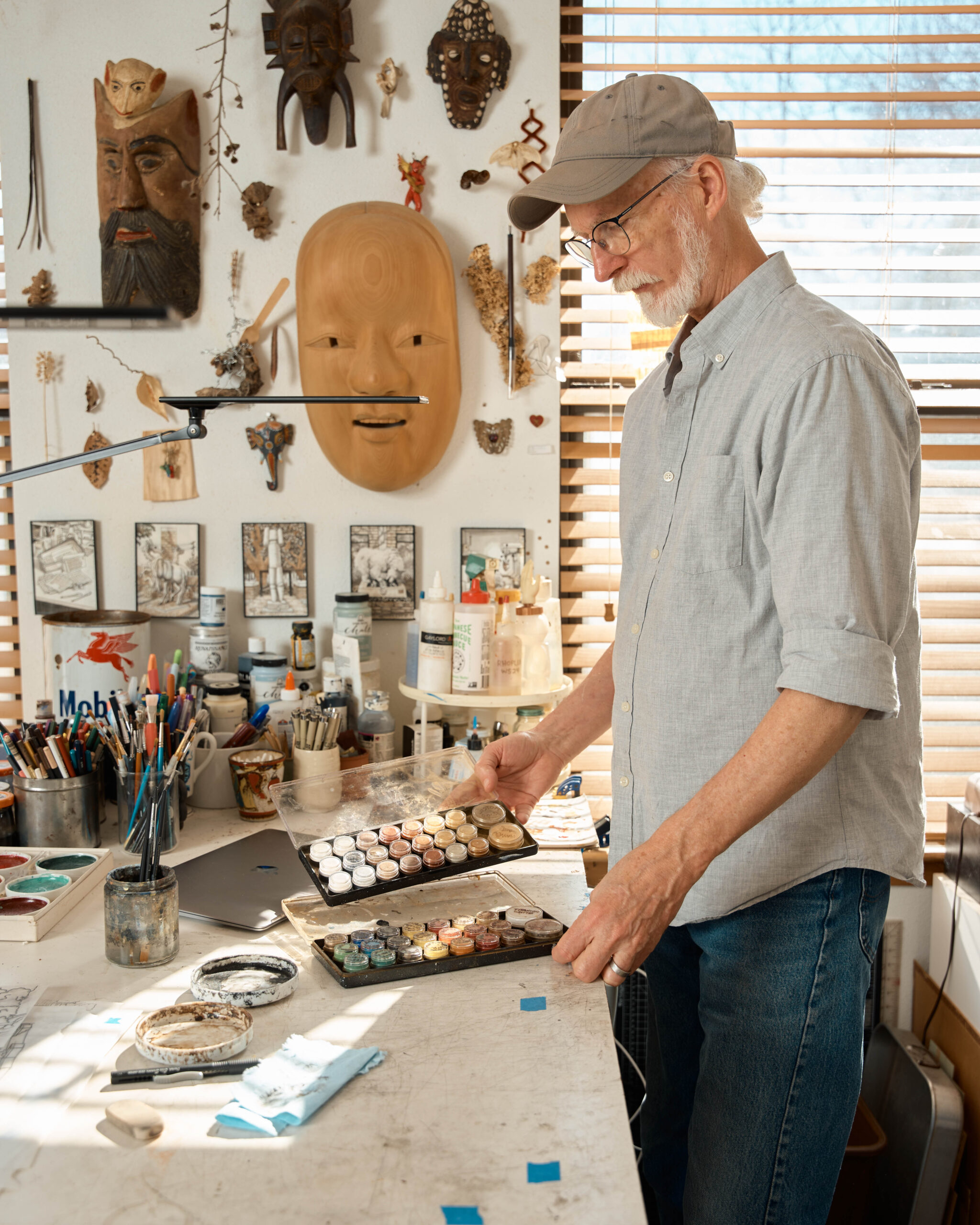
“There was this creative environment that I grew up (in),” he says. “I was playing with X-ACTO knives at a very young age, which would probably horrify me now if I looked and I’m like that 5-year-old is playing with a really sharp knife, and nobody’s looking at it.”
That upbringing led him to lead a 25-year career in art conservation, though he’s now retiring from that business and has turned to teaching drawing classes.
Smith spent the past six years doing historic drawings, and his research led him to ghost hunting, so to speak. He looked through newspaper archives and local history Facebook pages and blogs to find instances of sudden, tragic and unusual deaths.
“When you’re looking at headlines, people have been killing themselves the same way for hundreds of years,” he says. “You find the headline that (says), ‘Murder,’ and it’s like these are two people that got into an argument about something really stupid, and they stabbed each other. That’s 200 years ago, and that’s last week. So it’s got to be something kind of unusual that sets it off.”
It also helps inspire Smith if he has a personal connection to the place he’s depicting, like if it’s somewhere he drives by all the time. If he is to sketch the location, he must also be able to find the address and visit to see if there’s anything there to be drawn.
There are two kinds of ghosts in this work — the unsettled spirits of those who died but also the event itself that has become forgotten by the public at large.
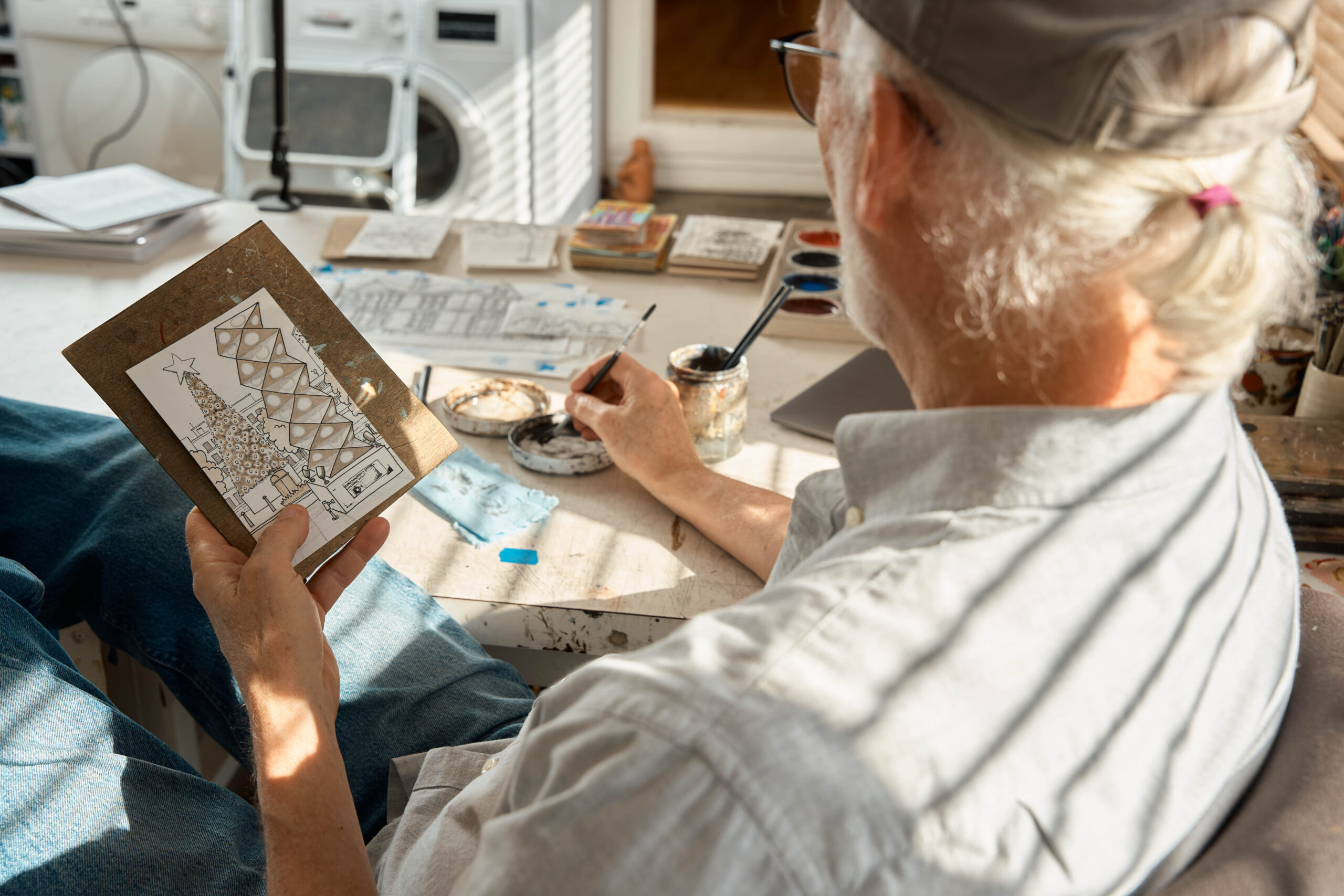
Though not as disturbing, Smith’s other art books explore absence, too. House of Giller is his depiction of inside the home of his longtime friend and fellow East Dallas artist Susan Giller, who since passed away, during the times when he would house sit for her.
“Basically, it was never intentional to document her house, but what the heck are you going to do?” Smith says, mentioning that her neurotic cat hated everyone but Giller. “When she died (in 2024), I realized that I had all these drawings of her place, and then after we had the estate sale, and I was back at her little bungalow, it was like she just disappeared. Even when her house still had the things in it, because she wasn’t there, they were losing their sparkle.”
Nine Days With LiHua is made up of works he created from inside his friends’ New York apartment while he was looking after their cat, LiHua.
Despite invoking them both by name in the titles, Smith doesn’t draw Giller nor LiHua. Giller’s face is included via a self-portrait she made of herself, and LiHua’s face, obscured by a curtain, is shown in a photo. In LiHua’s case, the point is to show her home, which is everything to a cat, and make the viewer see the world through her eyes.
“The cat is present in her absence,” Smith says. “This is where she sleeps in front of the radiator. This is where she scratches her little paws. So she’s present, but like a ghost, I never saw her. I’ve cat sat for her four times, and she’s like a ghost. You only hear her as a bump in the night or as something out of the corner of your eye as she darts from one room to the other.”
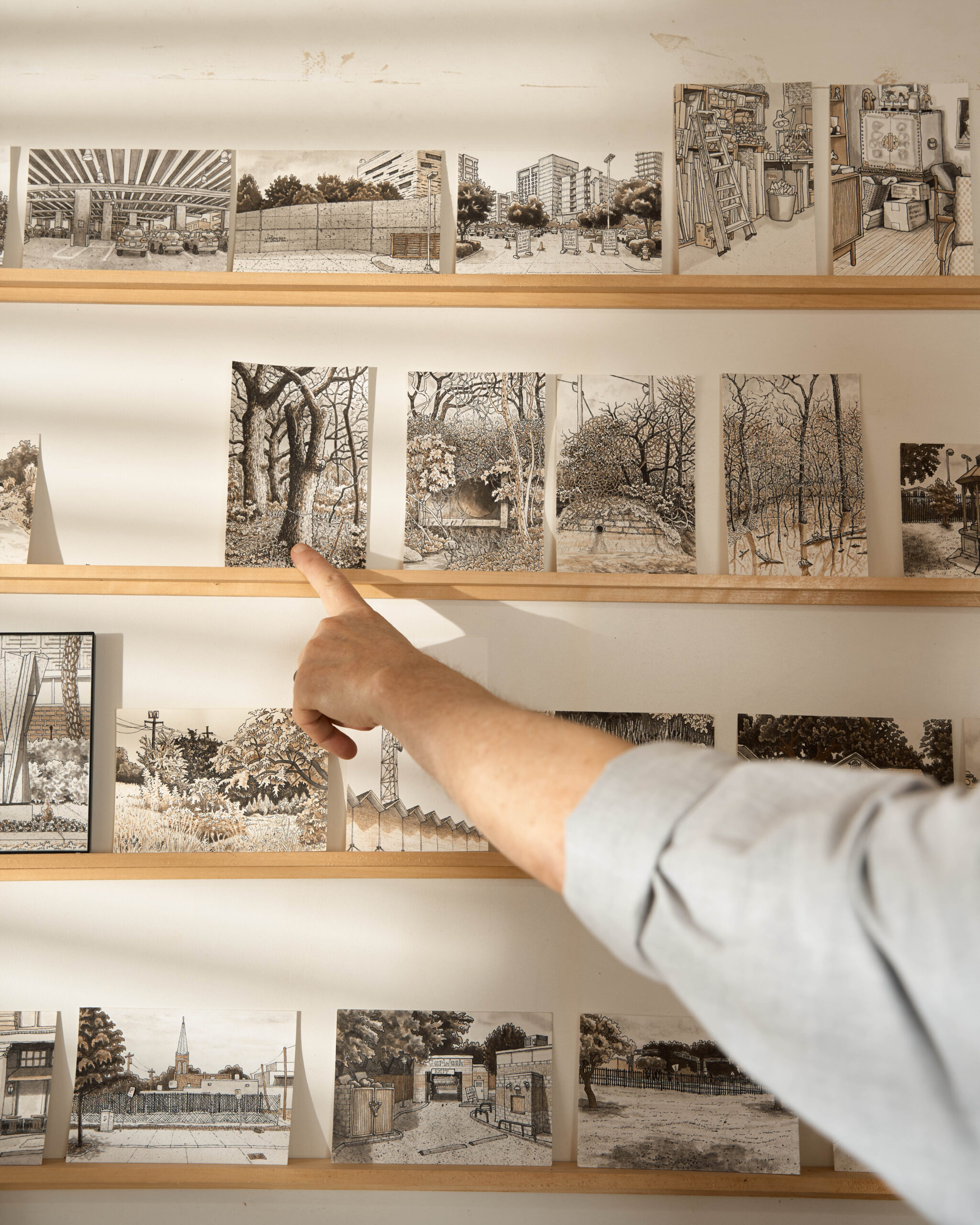

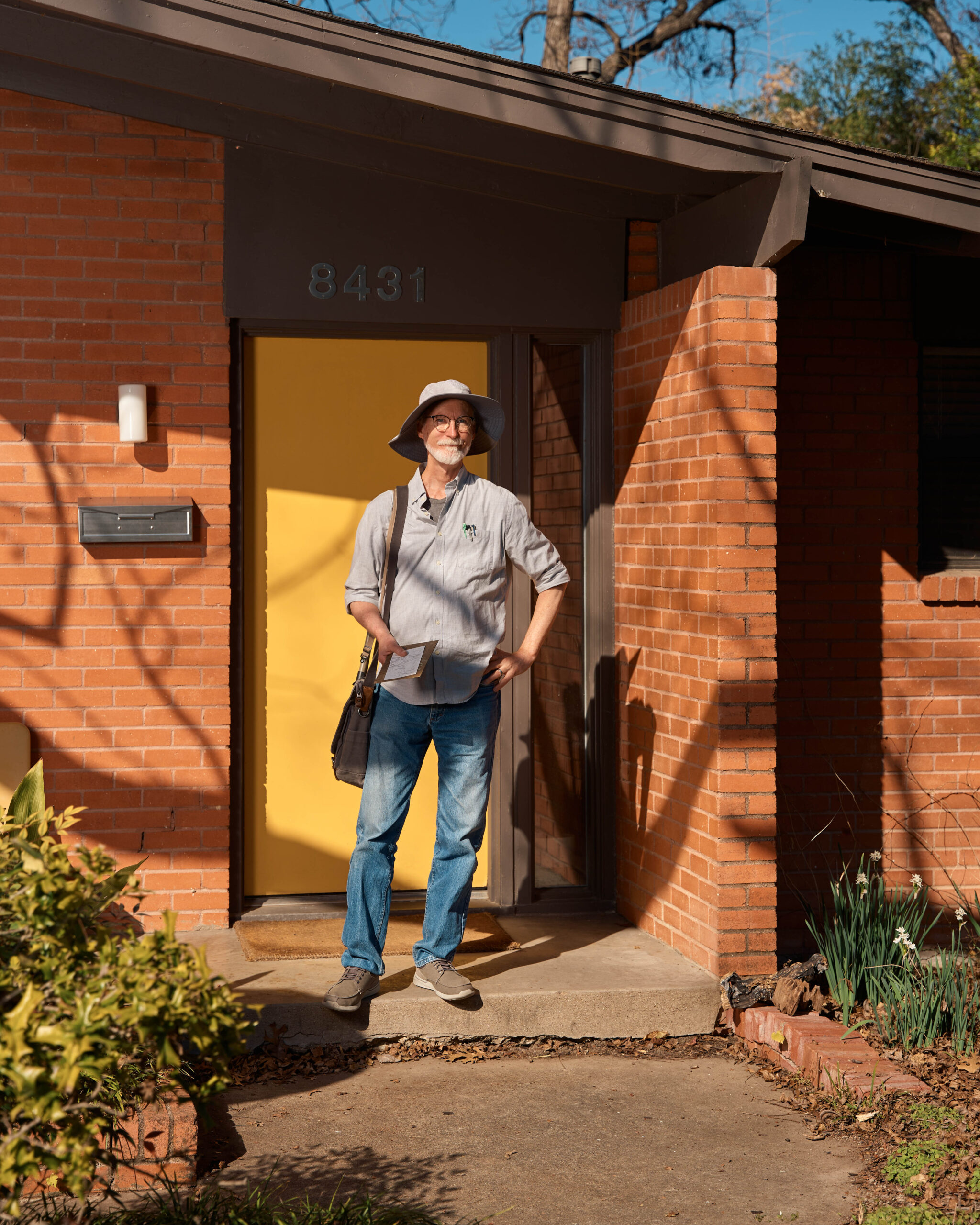
Where To Find A Ghost also confronts some of Dallas’ ugly truths. A few of Smith’s drawings are about a married couple who were killed in separate explosions by gangster and later Las Vegas casino owner Benny Binion. Two others tell the story of how a mob of white men threw a Black man out of a window at the Old Red Courthouse, beat and then hanged him from a steel arch downtown. Smith remembers when the historical marker was put up in 2021 at the corner of Main and Akard Streets that describes how Allen Brooks was lynched without due process.
Smith will admit that this isn’t cheerful work, but he descends into the gloom and gore for a reason.
“It’s like I’m refinding these people, and I’m giving them a voice and bringing them up to the public again.”