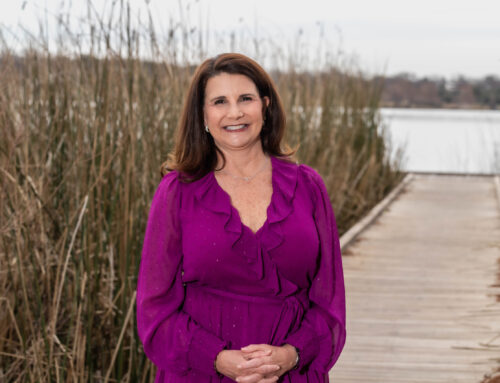
While cleaning up the cemetery next to her home, Forest Hills neighbor Julie Fineman experienced an awakening of sorts.

Photography by Amani Sodiq

Photography by Amani Sodiq
Fineman came from California to Texas and at first, wasn’t too interested in our state’s cultural history, just the natural history. During the clean-up at Warren Ferris Cemetery, she met the late Susanne Starling, who gave Fineman a copy of her book Land is the Cry!: Warren Angus Ferris, Pioneer Texas Surveyor and Founder of Dallas County.
“I read the book and fell in love with who Warren Ferris was,” Fineman says.
Warren Angus Ferris was from New York and moved to Texas back in 1836, before it became part of the United States. Locally, Ferris’ claim to fame is his work “survey(ing) the three forks of the Trinity area and help(ing) set the boundaries for Dallas and other nearby counties,” according to the historical marker at the cemetery. Ferris started the burial site on his family farm in 1847 after his son died. He and his second wife, as well as more of his children, are buried at the cemetery along with other “early Dallas County settlers.”
The last burial took place just after the turn of the 20th century, but the gravestones don’t exist anymore because of vandalism and the passage of time.
In 2017, Fineman and her husband moved to their home located next to Warren Ferris Cemetery. The area was described by the Friends of the Warren Ferris Cemetery’s website as previously being “an eyesore and embarrassment to the neighborhood.”
“When they moved here, that area … you could hardly even walk in it,” says Harryette Ehrhardt, a former state representative who Fineman sought guidance from on the cemetery project.
That has changed in less than a decade because of the efforts of the Friends of the Warren Ferris Cemetery. Now, you can stroll through the cemetery at the corner of St. Francis Avenue and San Leandro Drive on a self-guided tour. Along the path are little signs with ecological lessons printed on them. One reads, “Dead trees are filled with life. Leave fallen trees, stumps and branches. They create an important habitat.” There’s a similar message about not picking up leaves because insects and birds need “fallen autumn leaves for nesting and foraging. To help their population thrive in your backyard, don’t dispose of your leaves.”
“We have passive educational signage to empower and educate,” Fineman says during a tour of the cemetery. “The naysayers come in, and we hope they leave feeling not so much of a naysayer anymore.”
The cemetery is also a National Wildlife Federation-certified habitat. The cemetery’s inhabitants include owls, armadillos, opossums, coyotes, squirrels, birds, rabbits, snakes, butterflies and moths.
After moving into her home, Fineman got involved with the Dallas chapter of the Native Plants Society of Texas and Texas A&M AgriLife Extension’s Master Gardener and Master Naturalist programs. Armed with education, Fineman turned her attention to the cemetery.
“Non-native plants (in this case, privet) are called invasive or exotic plants,” Fineman says. “Because they’ve been brought in intentionally or unintentionally from other countries, they don’t have predators that can disrupt their lifestyle … in this new space. And so because of that, they’re free to run amok. There’s no checks or balances that have evolved over millennia between the relationship of flora and fauna, and so then they outcompete the native vegetation that came before and robs them of their sunshine and any other environmental factors that help to benefit their survival.”
But this isn’t just an issue for plants. Former Native Plants Society of Texas President Kim Conrow says the invasive plant takeover means no year-round food for wildlife, meaning it’s no longer life-sustaining.
Ehrhardt adds, “It was a natural disaster for plants, but it was also a natural disaster for our pollinators, for our birds, for any of the indigenous animals that wanted to live here.”

Photography by Amani Sodiq
Texas’ Blackland Prairies were life-sustaining and attracted early settlers who wanted to farm in Texas.
“Originally, the pioneers came here because the Blackland Prairie was rich and ripe for the picking for farming,” Fineman says. “Blackland Prairie is integral, instrumental in the survival of wildlife that’s not only local but migrates between here, Canada and Mexico and everything in between.”
The problem is that native Blackland Prairies are largely lost, thanks to development, row-crop agriculture and overgrazing, according to an article on the Native Prairies Association of Texas’ website. This is where cemeteries can be particularly useful because graveyards are usually untouched by farming or development.
“So the native seed banks that lay dormant underneath the soil now have an opportunity once we stop the mowing or we pull out the invasive plants that rob the sunshine from these native species,” Fineman says. “This allows them to regenerate, which then supports building the pollinator populations that include insects and spiders and birds and mammals.”
Fineman found expanding the restoration of graveyards beyond Warren Ferris Cemetery to other neglected Texas cemeteries could make a big impact. With the help of Ehrhardt and Conrow, the Constellation of Living Memorials program was established to implement this concept at other cemeteries. The program has also partnered with the organization Texan by Nature, Texas A&M AgriLife Extension and the local communities.
“If we can even take one-tenth of a third of those cemeteries and restore them to wildlife habitats, to resurrect what once was, a little bit goes a long way in helping the birds, the bees, the butterflies,” Fineman says.
Currently, five other Dallas cemeteries are participating in the Constellation of Living Memorials program — Albert Carver Cemetery, Western Heights Cemetery, W.W. Glover Cemetery, Oakland Cemetery and Beeman Memorial Cemetery. People can sign up to volunteer at these cemeteries on Constellation of Living Memorials’ website.
Sure, that’s great for the birds and bees, but could this help our fellow Texans?
Ehrhardt thinks so.
“We don’t water or fertilize or blow or mow this cemetery. If you just took the money that was used to do that for just the cemeteries that are having cursory care, that would eliminate a lot of expenses for these little towns or little churches or whoever is caring for it,” she says. “If you then go one step further and show what could be done by using those same native plants in people’s yards as Julie is doing here … if we were actually to make it acceptable and positive to have the kind of native plant yards in our businesses and in our residences, we would have no water problem in this state.”
Conrow adds, “Also, helping native habitats are so good for human health, not only our physical health but our mental health.”
One way the program can help Dallasites’ mental health is through giving people something tangible they can do to address climate change, not just what we think our leaders should be doing.
“You don’t need to go to another country to solve a problem,” Fineman says. “You can do it right here in your own neighborhood. And I think that’s critical because people feel helpless and hopeless, and by activating them to participate takes that frame of mind to a place from negative to positive.”