The year is 1905. At the turn of the century, Dallas led the Southwest’s book, drug, jewelry and wholesale liquor market plus the world’s inland cotton market and the manufacture of saddlery and cotton-gin machinery. Businessmen were trying to grow our city’s population, and then-U.S. President Teddy Roosevelt came to visit Dallas in good spirits.
And on Oct. 3 of that year, the State Dental College opened its first fall session in a grocery store where the Adolphus Hotel is now in Downtown.
We now know that school by a different name — Texas A&M University College of Dentistry, currently on Gaston Avenue, just north of Deep Ellum. Before that, the institution had the Baylor name attached to it for decades. This year, the college is celebrating its 120th anniversary.
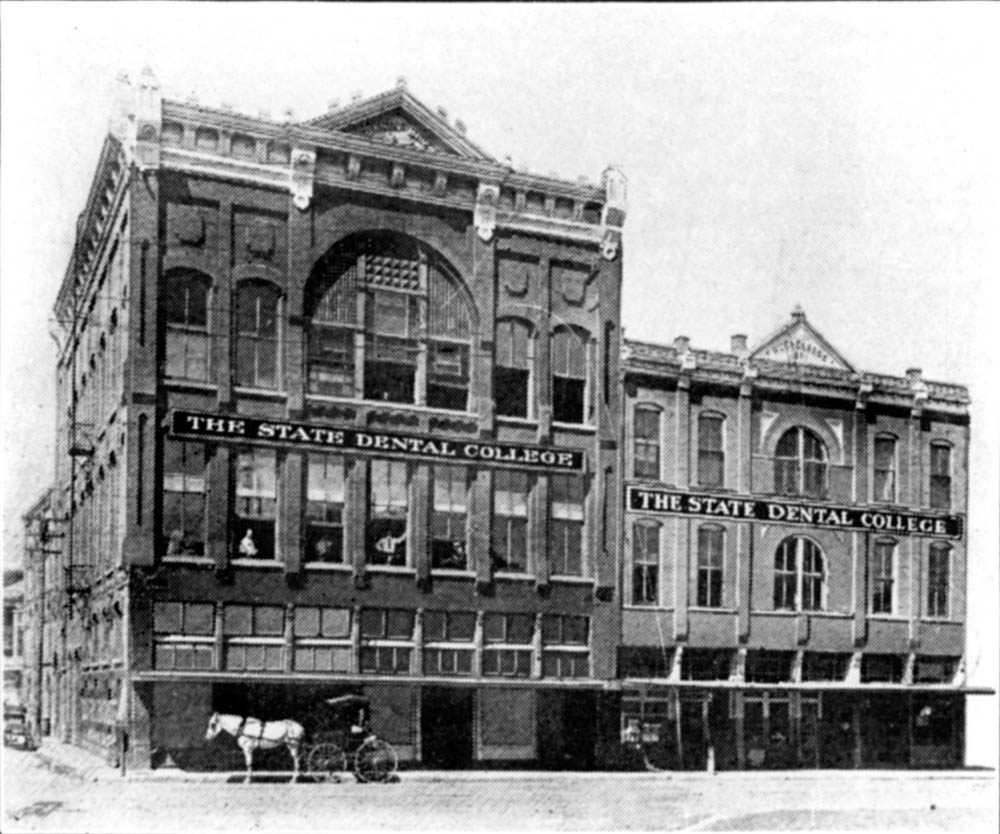
Photo courtesy of Texas A&M University College of Dentistry.
The early days
Forty students came to the State Dental College in 1905, according to Baylor College of Dentistry: The First 100 Years (which was used to map out the school’s past in this article). Four — one Texas resident, two from present-day Oklahoma and one from Japan — graduated the next year, having already studied at other schools prior. Tuition at the time cost $100 for the year and $65-$75 for dental equipment. Room and board was available at boarding houses for $15-$25 per month.
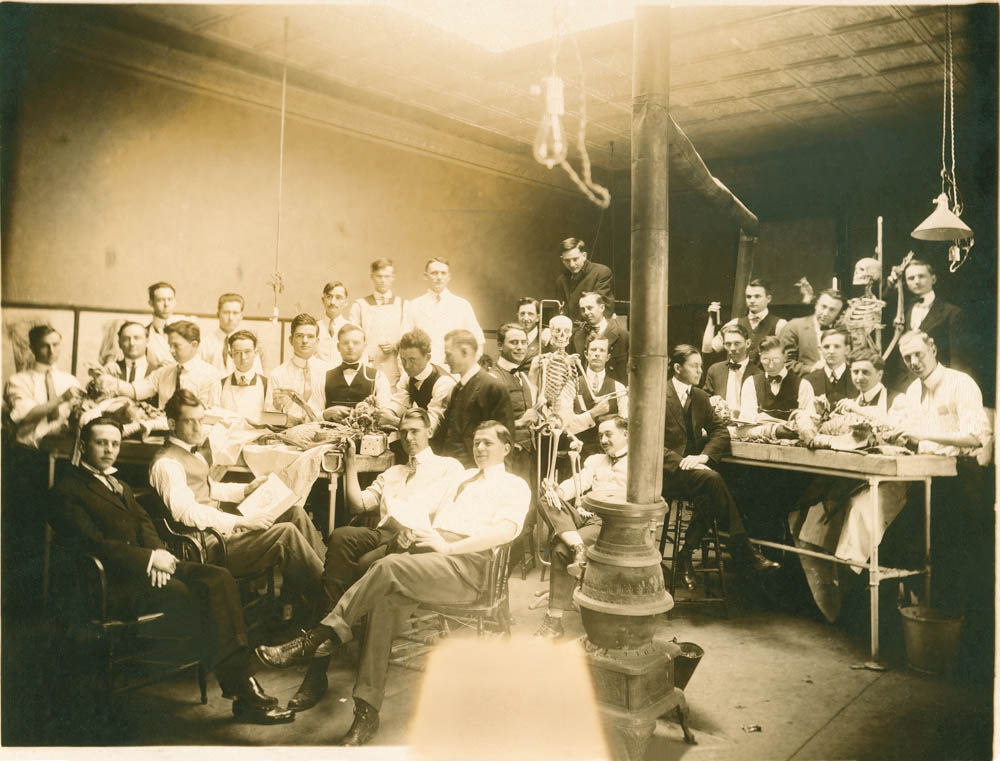
Photo courtesy of Texas A&M University College of Dentistry.
The college was established because Dr. David E. Morrow, a previous faculty member of a former St. Louis dental school, had been studying Dallas to see if our city could support such an institution. Dallas seemed like a good place for this concept because of the energy and growth at the time, but there was some opposition from local dentists. Many Texas dentists didn’t think our state needed a dental school because students could attend in other states.
Also, not all Texas dentists (less than half) had a college education at that time because they preferred apprenticeship training instead. The First 100 Years claims that some dentists didn’t want to invite competition via a dental school.
Still, Morrow persevered with the support of two local dentists (Dr. W.G. Rice and Dr. Henry L. Adler) and was aided by another St. Louis dentist, Dr. T.G. Bradford. With Bradford, Morrow applied for the charter and raised $4,500 to open the college.
“We soon decided that the organization should be completed without the aid of local men,” Morrow wrote in a board report, according to The First 100 Years.
The State Dental College did not have runaway success. Some of the challenges included lower than expected enrollment, students dropping out because of another financial panic in 1907, the school borrowing money to cover costs, and multiple dean changes. This included Morrow’s resignation as the first dean in 1907, which was suspected to be motivated by low enrollment. He did come back in the 1908-09 school year after another dean left, but he didn’t stick around to lead as dean.
However, State Dental College’s graduates were passing the state board exam, and the school had the largest freshmen class in the region in those early years.
In 1915, the State Dental College’s board of directors elected eight local dentists to serve on an advisory board that would oversee faculty and curriculum. The advisory board vice president, Dr. Bush Jones (Dallas dentist, one of the college’s educators and leading advocate for legislation regulating dentistry), became the college’s next dean.
Dr. J.J. Simmons, former Dallas County Dental Society president, initially pushed for local dentists to get involved in the college and headed up the advisory board.
“He went to work and brought order out of chaos, and there has never been a time in Dallas in many years when conditions were so good professionally speaking,” wrote Dr. C.C. Weaver, the college’s former secretary, in a letter, according to The First 100 Years.
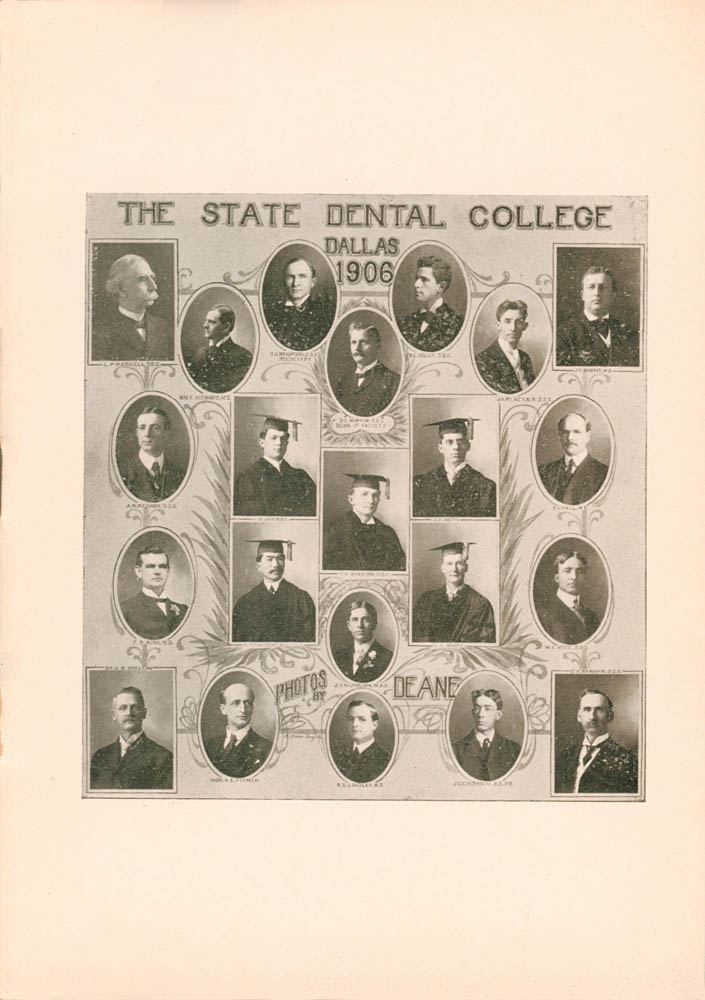
Photo courtesy of Texas A&M University College of Dentistry.
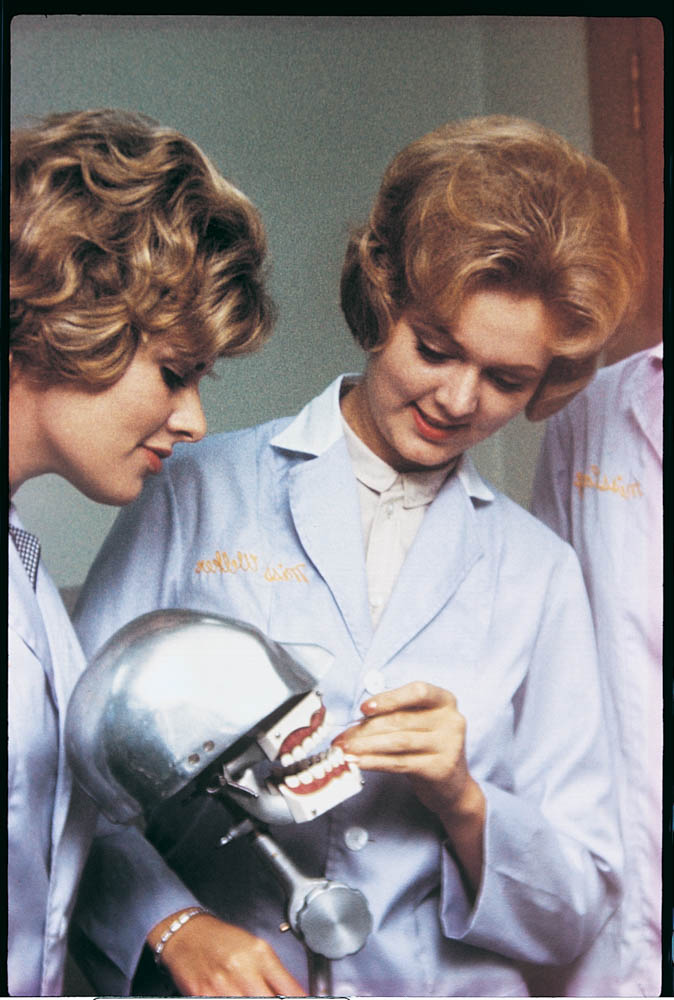
Under the Baylor umbrella
Dallas’ Baylor University College of Medicine acquired State Dental College in 1918. The change was prompted when the U.S. entered World War I in 1917, and the idea of drafting students from schools not affiliated with universities was being considered.
Early in its existence, State Dental College moved around to South Ervay Street and then to where City Park is now. Once acquired by Baylor, the college moved to 1420 Hall St. in a Southern Methodist University-owned former medical school building.
Becoming the Baylor University College of Dentistry lifted the school’s profile in the 1920s. It was nationally recognized by the Carnegie Foundation and received a Class A accreditation rating, the only dental school in the Southwest to achieve that distinction for many years.
What was less than ideal was the college’s facilities. Problems included exposed steam pipes raising the temperature and chronic flooding. It didn’t help that Baylor University College of Medicine moved to Houston in 1943, leaving behind the dental school but taking science faculty and property.
“In moving, the medical school took with them not only the scientific instruments, apparatus and supplies necessary for teaching the basic science courses, but most of the furnishings of the buildings including electrical and plumbing fixtures,” biological chemistry professor Dr. Charles R. Steward wrote in a 1952 Baylor Dental Journal article, per The First 100 Years. “The old dilapidated buildings, now stripped of most of their furnishings, looked like the wrecking crews had already started to work.”
Baylor University College of Dentistry’s next dean, Dr. George L. Powers, brought on facilities improvements, new faculty and a new dental clinic building at 800 Hall Street, finished in 1950. Four years later, another construction project to rebuild the basic science wing was completed, and space for graduate and research studies was added in 1960. Renovations to double the building size took place in the 1970s, and the main entrance was moved to Gaston Avenue at the address it has today.
The science wing also gave way to the creation of the dental hygiene school, helped by a $30,000 gift from W.W. Caruth Jr. to buy equipment needed. The first class started in 1955 with 32 students, who were reportedly all female.
The dental school has been known under multiple names over the years. One of these changes came in 1971 when the college disconnected from Baylor University and just became Baylor College of Dentistry, which was needed to sever ties with the Baptist denomination to accept subsidies from the Texas Higher Education Coordinating Board as well as federal funding. The subsidies were an incentive for Texas students planning to practice dentistry in our state as a means of dealing with a dentist shortage.
Then, in 1995, the college joined the Texas A&M University System to ensure long-term financial security.
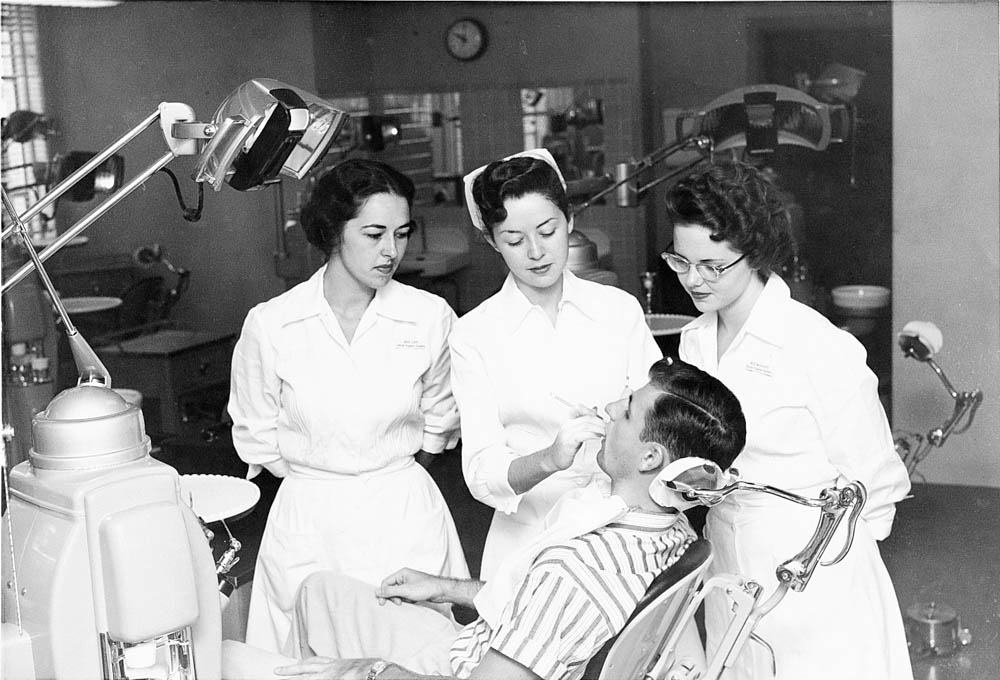
Photo courtesy of Texas A&M University College of Dentistry.
Return of the alumni
Two of the dental school’s prominent staffers today once attended when the college still had the Baylor name attached to it. One was Dr. Lily T. García, a South Texas native who became the college’s first female dean in 2022. In the 1980s, García came to Dallas for dental school after already attending the University of Texas at Austin for her undergraduate studies.
“I felt welcome here,” she says of the school at the time. “I always tell students, ‘Go where you think you’ll be succeeding.’”
García’s education at the dental college allowed her to build connections as she proceeded in her career, which led her to taking on administrative roles at other universities. At first, she wasn’t interested in returning to Dallas to be dean at our Texas A&M University College of Dentistry. She was leading the University of Nevada, Las Vegas School of Dental Medicine at the time, but eventually realized what a great opportunity she had to “maintain the integrity and raise the profile” of her alma mater.
“This is a valuable asset for this DFW region when you think of some of the impact of what our faculty do, when you think of our surgeons are both physicians and oral maxillofacial surgeons and dentists,” García says. “They handle the majority of facial trauma in the DFW area, many of which patients are uninsured, so they handle some major cases. You come back, and you go, ‘This is a great place, and I don’t want us to be a hidden secret.’”
Another alumnus who returned to be on the faculty is Dr. Amp Miller, director of comprehensive dentistry and professor. The Dallas native, 78, is a graduate of Thomas Jefferson High School and is a current Lake Highlands neighbor. He attended dental school here from 1969-1973 and earned a prosthodontic certificate in 1980.
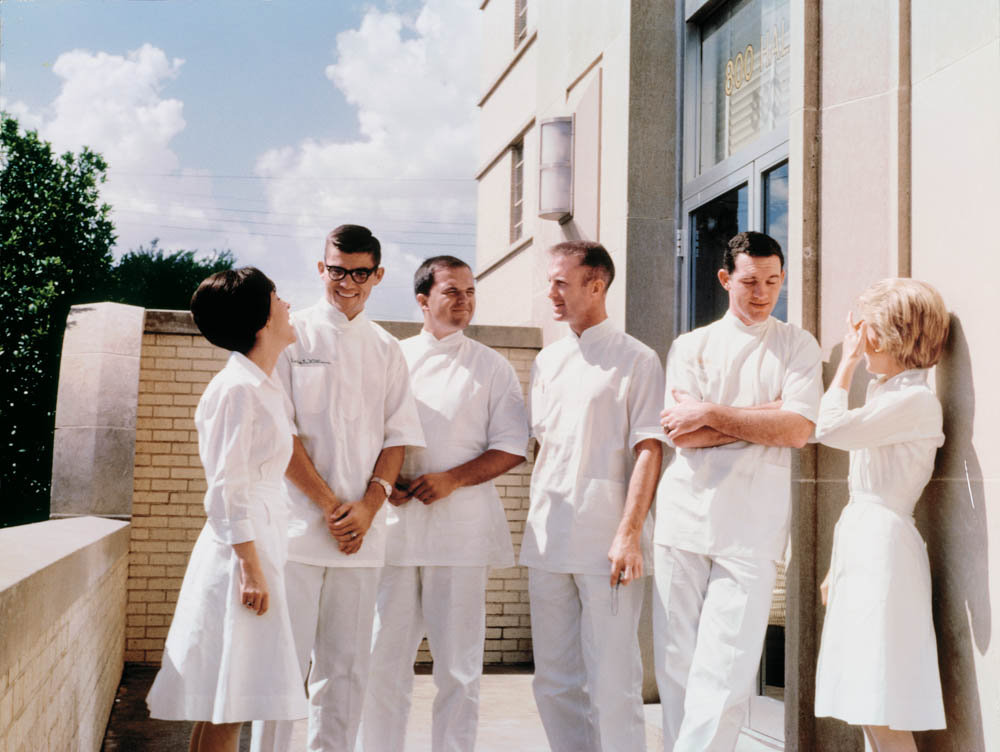
Photo courtesy of Texas A&M University College of Dentistry.
“It was mainly the guys in the classes,” Miller says of his time as a student at the college. “We had very few women at the time, and that’s gradually increased. The class size was pretty similar to what it is now. I think we had 100 in our class, and we got 106 in our classes that are entering now.”
Miller never really left the college. He’s been teaching here since the 1970s and even taught García when she was a student. Miller practiced dentistry, particularly prosthodontics, but says he has also enjoyed helping students learn, especially seeing them apply their knowledge to treat real patients, which is done under supervision from licensed faculty.
“They sort of come in here tentative and not really sure what’s going on, and then as they go through the second year and the third year and the fourth year, you watch them gain skills,” Miller says. “Maybe they get a little bit of swagger as they begin to know more things and begin to gain confidence in their abilities and what they know and how they would manage patients. That’s always kind of a neat thing.”
While new techniques are taught at the college, third-year dental student Michelle Wu says old-school methods are also covered, like silver fillings.
“There still is value in learning fundamentals, also the science and biology behind oral health, our gums, our teeth, the biology of the cells and all that stuff,” Wu says. “I think all that is still important before we start treating patients because then we can really understand why we’re doing certain things for treatment for patients.”
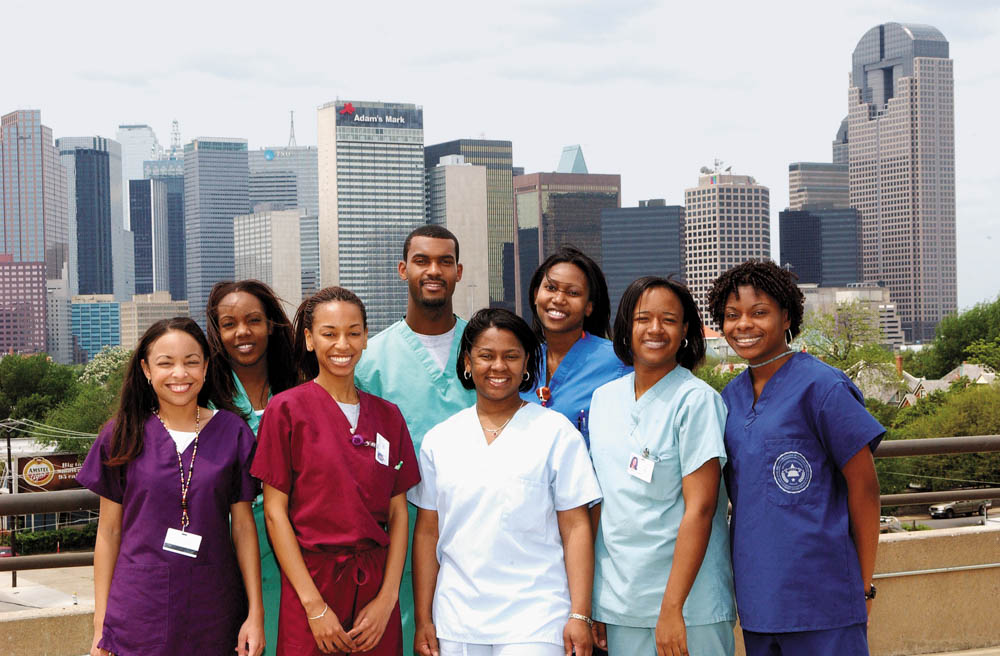
Photo courtesy of Texas A&M University College of Dentistry.
The college today
Adriana Vega, who is from Garland and expects to graduate from the dental college in May, draws compassion from her personal dentistry background when working with patients. As a child, Vega “needed quite a bit of dental work” and had her first root canal done as a 15-year-old.
“When it comes to patient care, the patient will always be like, ‘Oh, my teeth are really bad,’” she says. “I’m like, ‘You are here now, and that’s all that matters.’”
Since García was hired, she says her focus has been on talent, culture and facilities — hiring quality staffers, helping the college continue to be a special place, and investing in and taking care of the college’s spaces. She also nodded to the community members who receive treatment at the college, which helps train the students.
“We take the best of what we have and keep moving forward,” she says about the college’s culture. “We still show care, compassion, but we’re still demanding. And this is what a profession is, and that’s what the public expects you to have. It’s almost a higher level of integrity and accountability, which is really tough sometimes.”
The college’s leaders are also willing to make changes to better students’ experiences, says Wu, who is president of her class.
“There can always be those challenging conversations, but at the end of the day, I always have the feel that the administration is willing to hear us out and try to improve things for us,” Wu says.
To Vega, the culture of Texas A&M University College of Dentistry is supportive, both from the faculty and her fellow classmates. She’s grateful to those, including dentists who work with students, who keep the college functioning.
“Whether you’re first through fourth (year), everyone is trying to help everyone,” she says. “I remember receiving help back then from upperclassmen, so I really try to do the same for underclassmen here.”