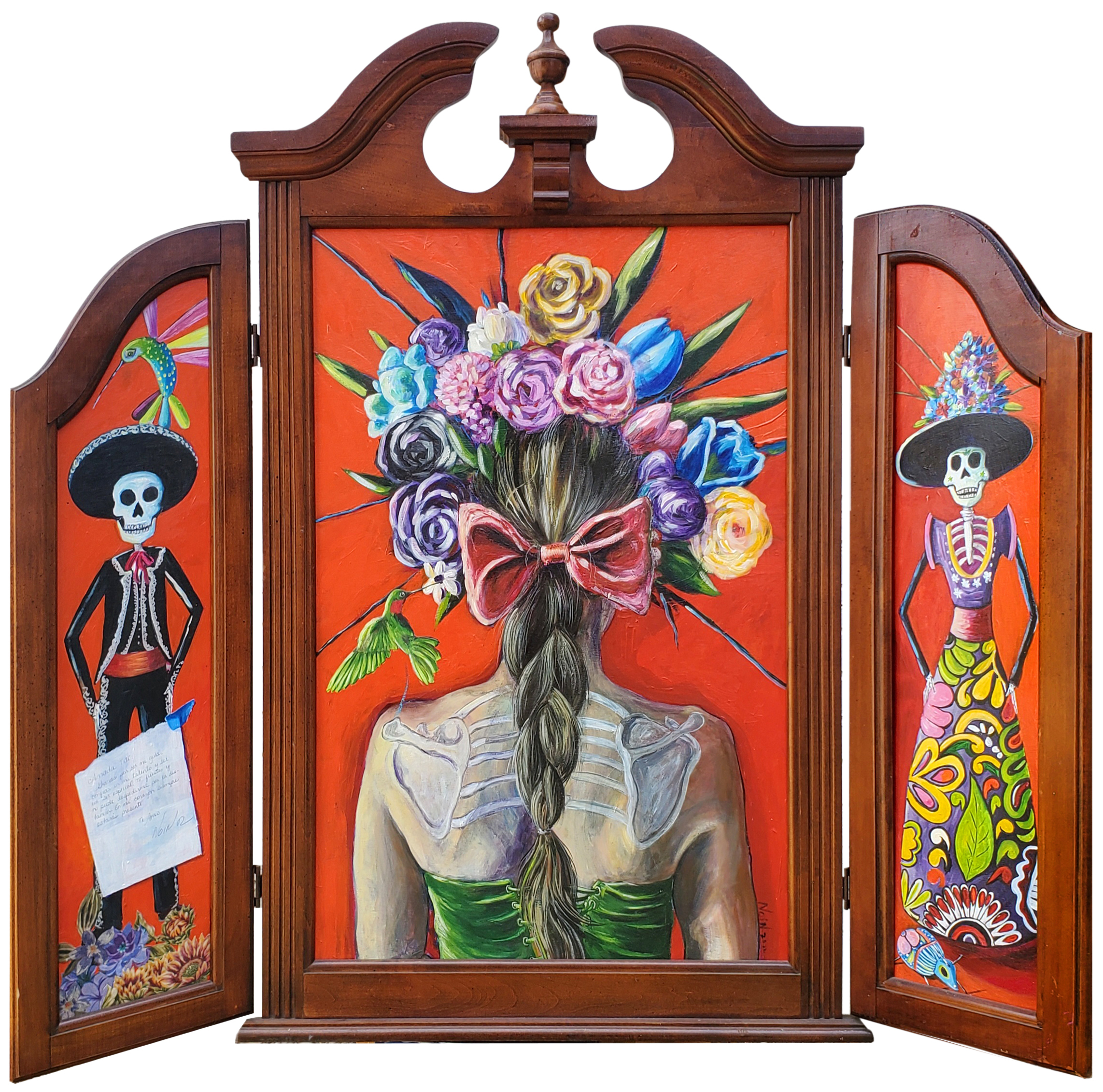
Repurposed dresser mirror frame at Bath House Cultural Center
When Bath House Cultural Center curator Enrique Fernandez was leading a tour of seven and eight-year-olds through the Center’s annual Day of the Dead Exhibition, the group stopped, awestruck, at one of the altars in the gallery.
Altars, or ofrendas, are an integral part of Dia de los Muertos. Family members display photos of lost loved ones and place the departed’s favorite items on the altars in anticipation of their soul’s return in early November.
As the children gazed at the exquisitely decorated altar, Fernandez overheard a boy marvel at the love and care that the honored individual had inspired. But another boy, who had probably seen Coco, was upset at the thought of individuals who didn’t have anybody left to honor them with an altar. He thought — as Coco portrayed — that as memories of an individual fade, that their spirits begin “disappearing.”
“Luckily, I had talked to a professor of anthropology and I knew about this celebration of the 30th of October,” Fernandez says. “When the spirits of people like that who passed away and were celebrated and remembered for years until they’re survivors begin to also pass away. And he said that the reason that people celebrated on the 30th was to honor the memory of those who didn’t have anybody else to remember them. When I explained that to the little boy in other words, he became very happy that there was an opportunity for the community to remember people who they didn’t know. He thought that everybody deserved a chance to be remembered.”
That interaction gave Fernandez the inspiration for this year’s exhibition theme. Entitled Día de Muertos: Messages of Love for the Forgotten and Disappeared, the exhibition seeks to honor those who don’t have a place on an altar anymore.
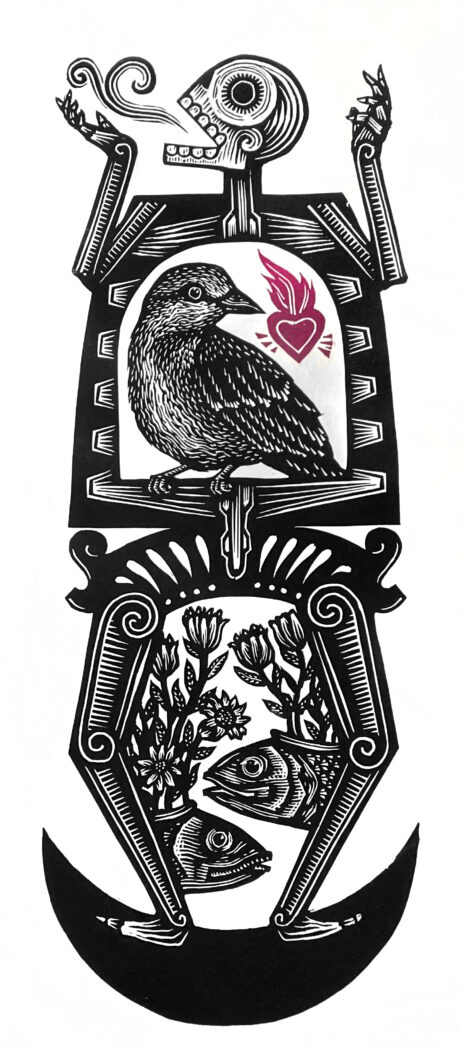
“El Poeta Linocut” print by Eduardo Robledo
Dia
Dia de los Muertos, or Day of the Dead, is commonly celebrated by Mexican and Mexican diaspora communities on November 1 (All Saints Day) and 2 (All Souls Day). On these days, it is believed that the spirits of the dead return to visit loved ones and friends, who welcome them with pan de muerto, marigold flowers and offerings of their favorites in life.
While it is celebrated in connection with Catholic holidays which arrived with the Spanish, its roots go back to indigenous Mexican society.
“[In Ireland] They adapted indigenous practice into a Catholic practice,” says Yolanda Chavez Leyva, a history professor at the University of Texas at El Paso. “And that’s what I see happened with the Day of the Dead. The Day of the Dead started out as a two month celebration before the Europeans. And in order to make Catholicism more attractive to indigenous people, they took those two months and put them into the two days of All Saints Day and All Souls Day.”
The original holidays took place in August and September, commemorating the harvest. The pre-Hispanic notion of death was much more transitory.
“It comes from being an agricultural society where there’s always that cycle of life and death,” Leyva says. “Which is why these two holidays were about the harvest, they were about the culmination of the agricultural season. That we could think of would also be the culmination of our lives. We were just like seeds that grow into plants that then die. So there was a respect for death, not a fear for death.”
As a reflection of pre-Hispanic ideas of life and death, the Day of the Dead is not a somber occasion. Instead, the return of loved ones, friends and ancestors is celebrated with great fanfare.
Families begin decorating altars in the runup to the holiday. The deceased’s favorite food, drinks, pictures and mementos are placed on the altar — which can be set up at a grave or in the home. Pan de muerto, or bread of the dead, is a common food during this time, as are sugar skulls known as calavera.
Many visit their loved ones’ graves to clean and decorate them. One of the most common decorations are bright yellow marigold flowers that are believed to guide the spirits of the dead to their family.
The holiday is mainly celebrated in southern Mexican states like Oaxaca, an epicenter of Dia de los Muertos celebrations. There are wide variations in Day of the Dead traditions across states, municipalities and even towns. In recent years, the Day of the Dead has become much more popular world-wide following cultural depictions like Coco.
Although November 1 and 2 are the most widely-celebrated days, there are lesser-known adjacent days used to honor specific spirits, such as unborn children and the drowned, with the 30th reserved for the forgotten.
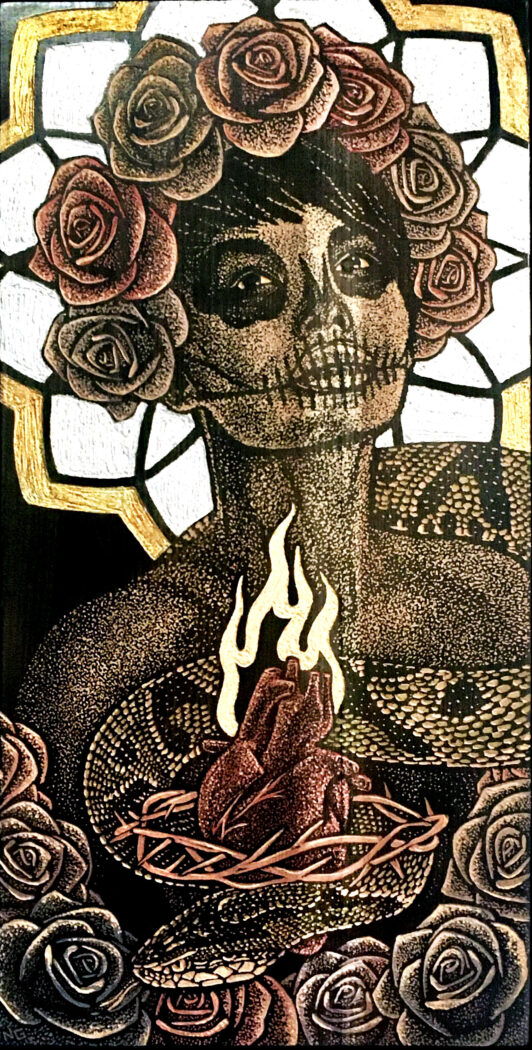 The Exhibition
The show has been a Bath House staple since 1986. Cora Corduna, the then-director of Teatro Dallas, was putting on a play traditionally performed close to the Day of the Dead, Don Juan Tenorio. She had altars displayed in the gallery to make the play a more immersive experience.
“It was just for that run of that play,” Fernandez says. “And little does she know that years later, we’re still doing that show.
Altars, including the one the two boys would be discussing years later, have remained a constant in the exhibition, now going into its 38th year. Fernandez says that most altars are built in honor of friends or non-family members.
“The others that are built by family members are very significant because they bring together members of the family,” he says. “There’s usually a person in that group who has artistic abilities, who can maybe direct the building of the altar, but the whole endeavor of putting the altar together, it’s a family effort.”
“And you hear them as they’re putting everything together, tell stories about the person or remembering an anecdote or something that happened with them and the person who was being honored. And there are moments when some of them are crying or sometimes they’re laughing.”
This year’s exhibition will be on display from October 12 to November 9, with an artists’ reception planned for October 13. Submissions, of which Fernandez says there are typically 250-300, are open to all forms of media. The show’s call for entries requested works to convey light and joyful messages. Paintings are common, but 3-D sculptures are also typically well represented.
“One piece that was very memorable was by a young artist who worked in a warehouse and he noticed that they were about to discard very large blocks of foam core that they use for packaging,” Fernandez says. “These were pieces that were probably three feet by three feet and they were really huge. And with that discarded material he saw a potential for doing an art piece, and he sculpted a full bodied skeleton out of foam core that was about 20 feet tall. And our gallery is only 11 feet high.”
Luckily, the skeleton was able to sit down.
Ahead of this year’s exhibition, Fernandez will narrow the 150-200 entries down to 65 displayed works.
“We’re curious to see how artists would interpret the theme,” he says. “Will they explore you know, the joyful side, the part that says yes, they’re gone. They’re not here with us physically. But we believe that there’s a reason for celebrating because perhaps where they are now is a place that’s bringing them that level of happiness and joy.”
That joy can be hard to maintain when thinking about people being forgotten or spirits “disappearing.” But for Fernandez, that interaction with those two little kids told him all he needed to know.
“I think seeing that face lighting up and the eyes getting some consolation that yeah, maybe people don’t have people to remember them, but there are always others who are willing to do that for you. To me, that made it clear that maybe there’s also a happy side.”